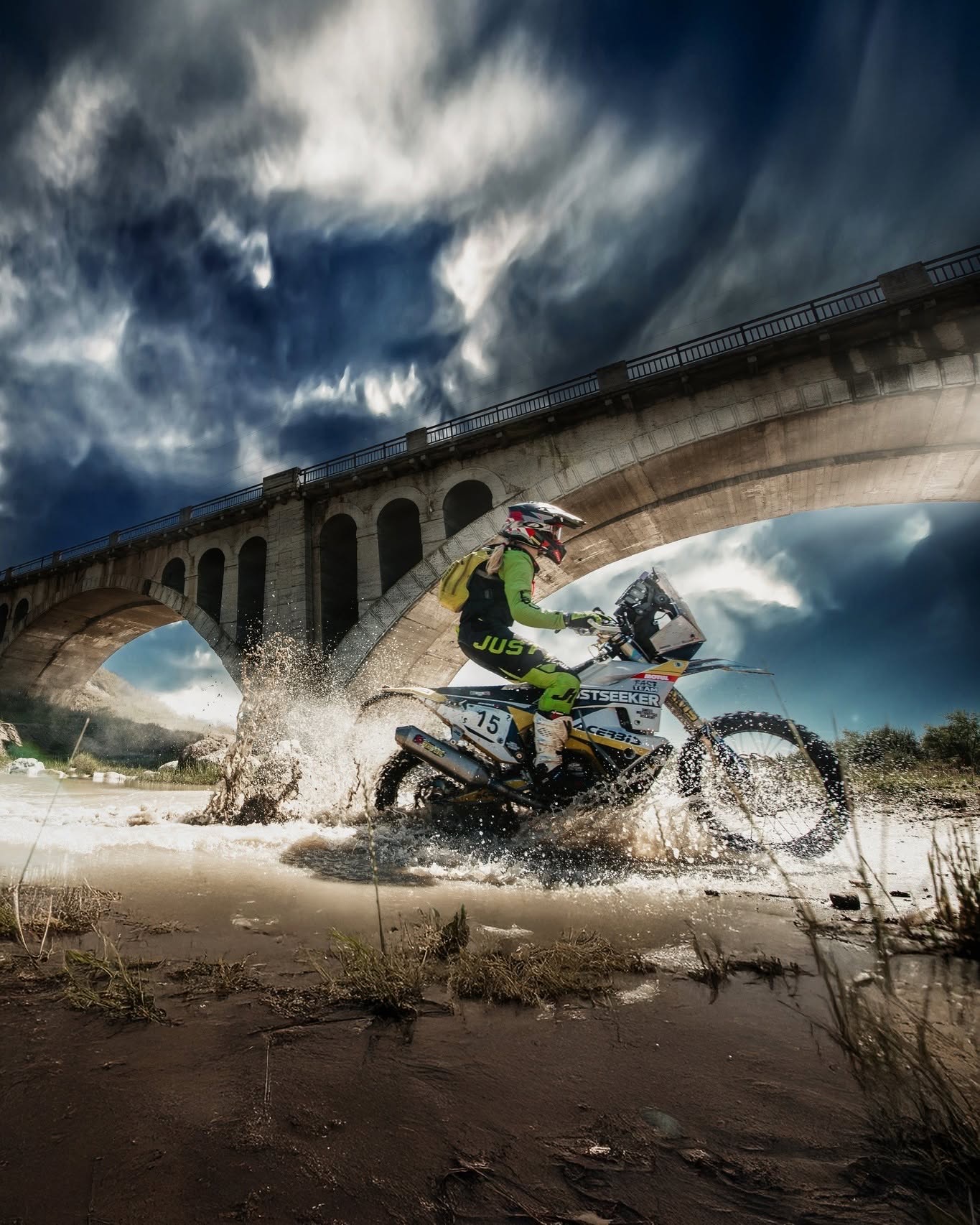

The RO Rally Marathon was held from 10 to 18 July 2026 around Râmnicu Sărat in eastern Romania. It was the third round of the FIM Europe Tout Terrain Rally Cup and, in 2026, the event’s first year as part of this European cup. The concept is based on classic rally raids: long daily stages, roadbook navigation, high speeds and a two-day marathon phase with a mobile bivouac. The organiser cites a total distance of more than 2,300 kilometres and daily routes of roughly 200 to 500 kilometres.
Landscape and character of the route
The rally led through a varied Eastern European landscape:
- open plains and farmland,
- rolling hills,
- long forest sections,
- fast gravel roads,
- sandy ground and changing surfaces.
FIM Europe describes seven demanding stages with forests, fast gravel tracks, gentle hills and technically difficult navigation. The organiser also stresses the variety of plains, hills, forest and sand.
So this was neither an extremely rocky hard enduro rally nor a pure desert event. The difficulty came rather from the constant switching between fast, flowing sections and tight or unclear stretches where riders had to navigate at the same time.
Level of difficulty
Overall, the RO Rally was demanding to very demanding.
The final classification shows how selective the event was: 55 riders were classified with a total time, while other participants were listed as “AB” (retired). Several riders also received extremely high stage times, which probably resulted from fixed-time allocations, skipped stages or penalties. However, the PDF does not state the respective cause.
How it unfolded
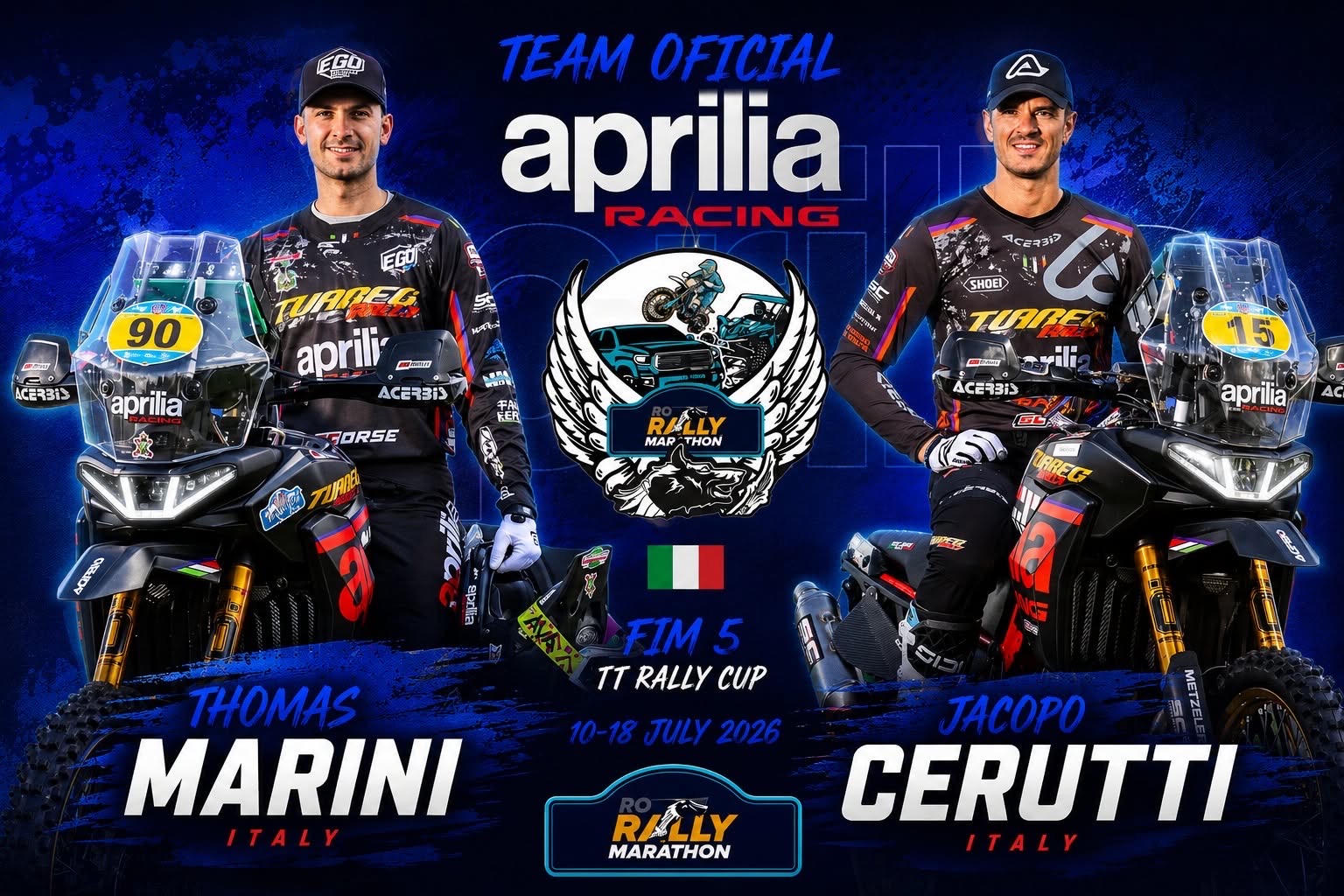
Thomas Marini wins – Thomas Marini of San Marino won the rally on an Aprilia Tuareg in 18:07:18 hours. He led from the first day and achieved a podium position on every special stage. According to Aprilia, he took four overall stage wins and five class wins. With this success he also took the lead in the Tout Terrain Rally Cup.
The official overall podium according to the timing PDF:
- Thomas Marini, Aprilia – 18:07:18
- Maikol Reboldi, Triumph – 19:29:59
- Yuri Di Pauli, KTM – 20:32:57.
The FIM Europe report, by contrast, names Alexandru Daniel Goran as third. This contradicts the official final classification, in which Goran is fourth. The report probably refers to a different partial classification or an earlier state of the results; the difference is not clearly explained there.
Maikol Reboldi’s comeback – Reboldi won the sixth special stage and moved up to second place with a strong finish. His Triumph was thus the best-placed bike behind the winning Aprilia.
Jacopo Cerutti’s accident – The most dramatic story of the rally was Jacopo Cerutti’s serious accident. On the sixth day of riding, he collided with an oncoming car on a special stage. According to Aprilia, Cerutti was not responsible for the collision. He suffered complicated fractures of the tibia and fibula in his right leg and a fracture of his left kneecap. The subsequent operation in Bucharest went well; Aprilia initially prescribed five weeks of complete rest.
His retirement is visible in the results list: after six strong stages, he is listed as “AB” on SS7. The incident raises a serious safety question: how did an oncoming car get onto or into a special stage? The collision and Cerutti’s lack of blame are publicly confirmed. The car’s exact access route, possible organisational errors and any legal consequences have not yet been publicly clarified. Statements about deliberate entry or specific people responsible would therefore be speculation.
The German participants
Three German riders appeared in the official overall classification. All started with a DMSB licence in class M2.
Jan Hendrik Erbach, KTM (95) – surprise in sixth place
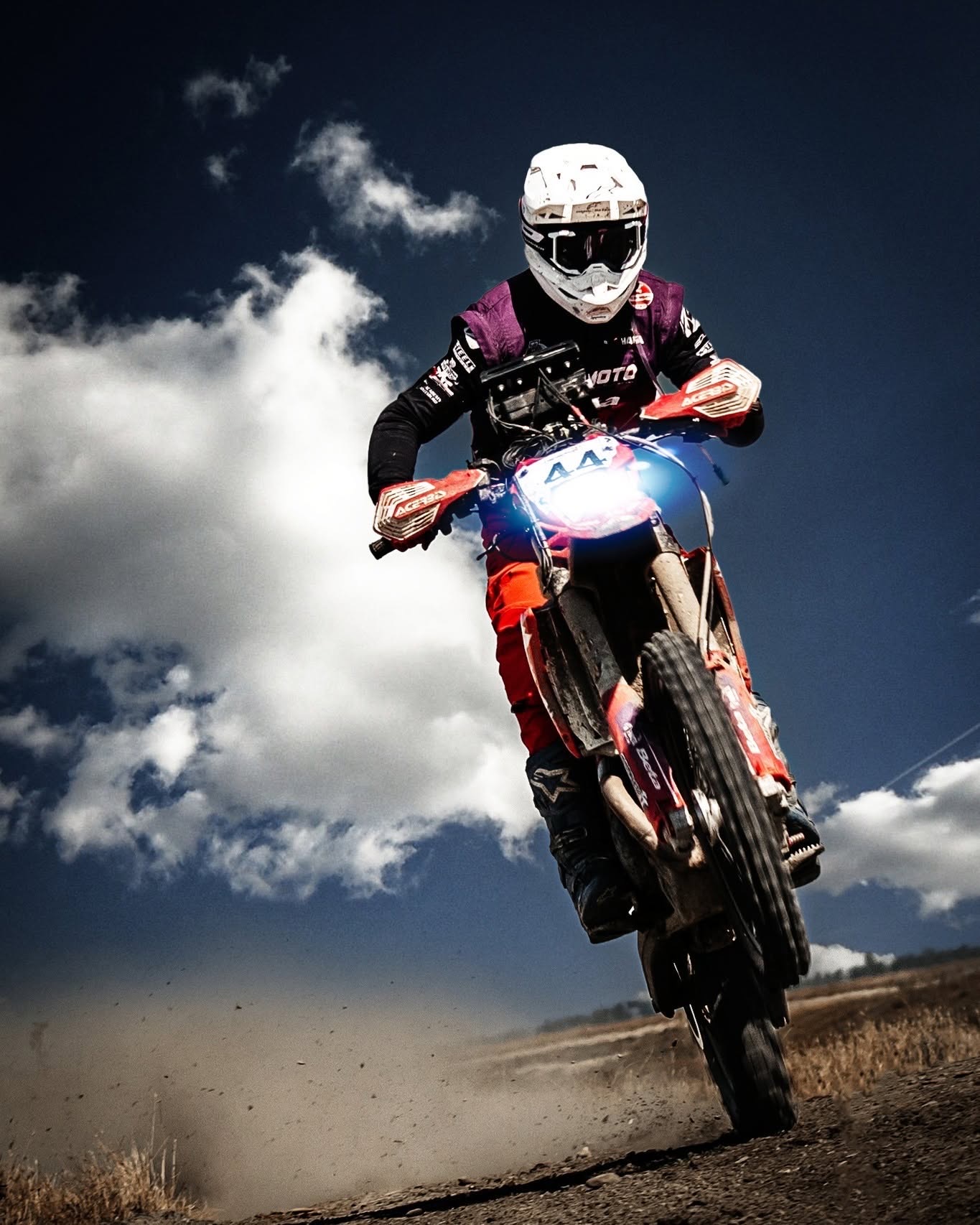
Erbach was the strongest German and one of the most eye-catching privateers of the rally. He finished only a little over 25 minutes behind M2 winner Yuri Di Pauli and left numerous nominal FIM Cup riders behind him. His third special stage was particularly strong: with 4:25:03 hours he was faster there than several riders who were ahead of him in the overall standings. His whole rally was remarkably consistent; none of his seven times shows a large fixed penalty or a massive slump.
Claudius Flogaus, Beta (2) – strong recovery after SS1
Flogaus lost a lot of time on SS1 with 8:06:37 hours. After that he rode much more competitively and steadily. On SS3, for example, he needed only 5:00:54, on SS5 2:35:11 and on SS7 41:28 minutes. This suggests difficulties on the first day and a successful recovery. Whether the time loss was caused by navigation, a technical problem, a crash or a penalty is not documented in the official result.
Tim Duerr, KTM (112) – enormous penalty or fixed time
Duerr’s overall result was practically decided by his SS1 time of 46:11:01 hours. His later performances were considerably better by comparison: 3:24:31 on SS4, 2:15:46 on SS6 and 39:09 on SS7. A first stage actually ridden in more than 46 hours is hardly plausible. A fixed-time allocation or massive time penalty after a stage not completed in the regular way is therefore the most likely explanation. However, this is only an inference from the data; the result sheet gives no reason.
Stories
- Marini’s win is technically interesting because the Aprilia Tuareg is a relatively large and
 heavy twin-cylinder motorcycle. On tight and technical tracks, lighter single-cylinder bikes are often considered more manageable. The Tuareg was apparently able to make particularly good use of its power and stability advantage on the fast Romanian tracks. Aprilia described the success as proof of the bike’s competitiveness and reliability under extreme conditions.
- Marini’s development from helper to winner
Before the rally, Cerutti was regarded as Aprilia’s most prominent rider, having won the previous cup rounds in Galicia and Greece. In Romania, however, Marini stepped out of his shadow, took the lead immediately and withstood the pressure throughout the week. - Classic riders on Honda
Dario Amorosa and Aneta Francu finished in the Classic category. Their total times of more than 93 and 100 hours respectively show how big the difference can be between a regular, competitive run and a result marked by problems or fixed-time allocations. - The car on Cerutti’s stage
It is confirmed that an oncoming car was involved and that, according to Aprilia, Cerutti was not at fault. It is unconfirmed whether the vehicle drove around a barrier, got onto the route by mistake, or whether the stage was not fully closed to traffic. - The differing podium report
FIM Europe names Goran in third place, while the official timing lists Di Pauli. A later correction, different cup and event classifications or an editorial error are all conceivable. Without an official bulletin, none of these explanations should be presented as fact. - The high times of several riders
For Tim Duerr and other participants, extreme individual times strongly suggest fixed-time allocations or penalties. Which incidents lie behind them cannot be reconstructed from the official document.
Conclusion
The RO Rally Marathon 2026 was a fast, long and navigation-heavy rally raid through the varied landscapes of eastern Romania. Its toughness lay less in extreme individual obstacles than in the combination of long distances, heat, high speed, changing surfaces, roadbook navigation and strain on the machinery.
In sporting terms, Thomas Marini’s commanding win, Maikol Reboldi’s late attack and Jacopo Cerutti’s serious accident defined the event. From a German perspective, Jan Hendrik Erbach’s sixth place overall and second in M2 was the standout result. Claudius Flogaus finished the rally solidly in 20th place after a difficult start, while Tim Duerr carried on despite an enormous time burden on SS1 and reached the finish.