
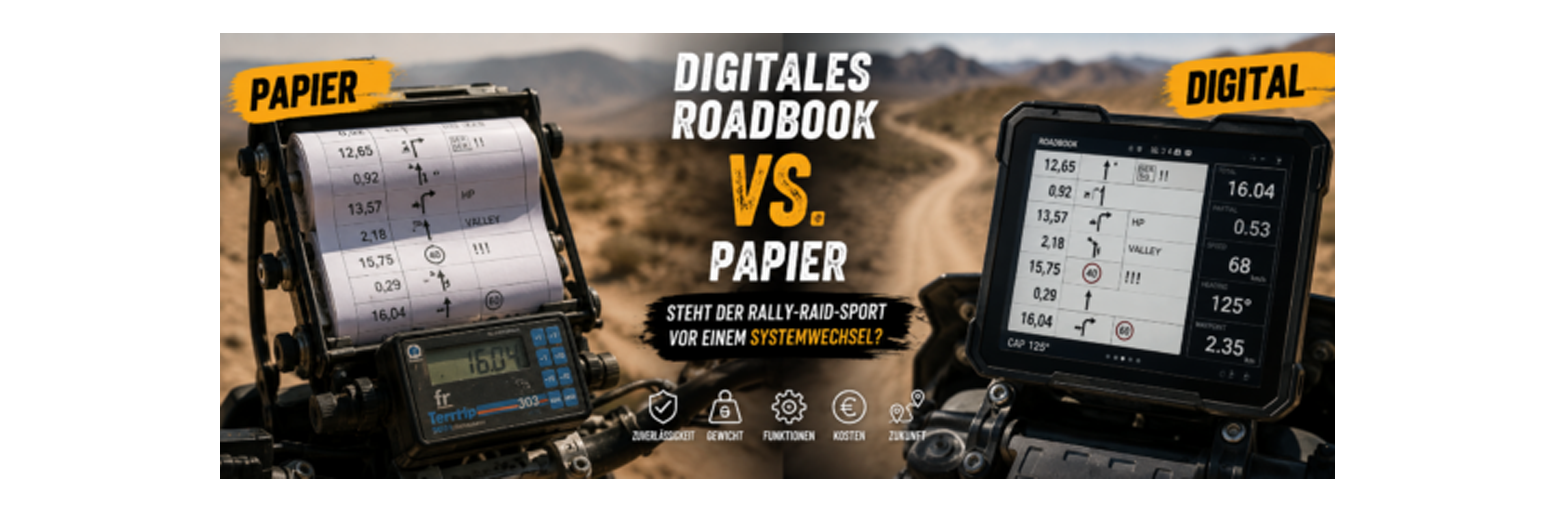
Digital Roadbook vs. Paper: Is Rally Raid Facing a Change of System?
The roadbook is as much a part of rally raid as dust, long stages and navigation errors. For decades there was no doubt what it looked like: a paper roll in a roadbook holder, plus a tripmaster, switches and a great deal of routine.
But that picture is changing.
More and more digital systems are coming onto the market, new event formats are relying on electronic navigation, and established rallies now offer paper and digital side by side.
The question is therefore becoming ever more relevant:
Is the digital roadbook merely a supplement, or is a fundamental change of system in rally raid now beginning?
Why paper was the standard for decades
The classic rally roadbook is technically fairly simple. A paper roll with tulip symbols, distances, hazard warnings and navigation information is wound through a roadbook holder as the route unfolds.
There are normally one or more tripmasters and handlebar controls as well.
The system has some major advantages:
- It is mechanically fairly simple.
- The rider can see several navigation notes at the same time.
- Many rally riders have known the system for years.
- Mechanical problems can sometimes be repaired directly in the bivouac.
- The system needs no complex software.
The Dinaric Rally also describes paper as a reliable solution and highlights in particular its good legibility in direct sunlight and its relatively easy repair.[1]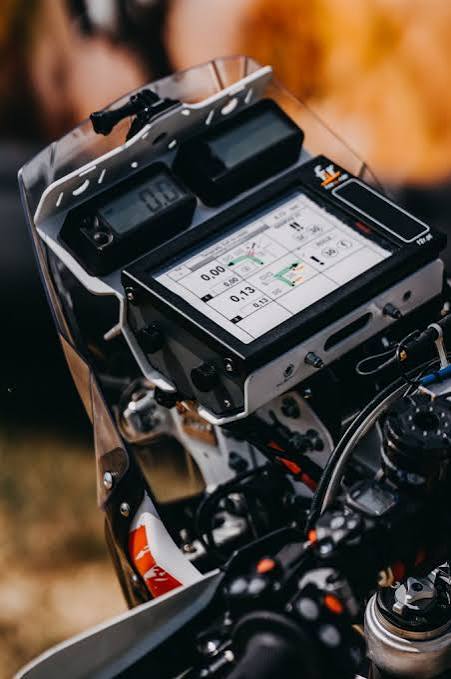
Why digital navigation is becoming more important all the same
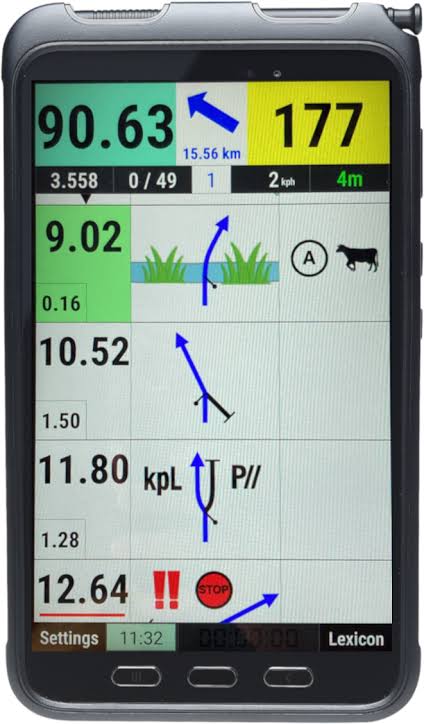
Digital roadbooks can combine functions that, in a classic rally cockpit, are spread across several devices.
A current example is the F2R Y1000. The device combines a digital roadbook, total and partial distance counters, speed, CAP display and waypoint navigation in a single system.[2]
F2R itself puts the change unusually clearly. The manufacturer says the transition to digital navigation is no longer a vision of the future but is already under way.[3]
This is particularly noteworthy because F2R has been strongly associated with classic paper roadbooks for decades and still offers paper holders and traditional navigation solutions.
F2R develops the Y1000 specifically for rally raid
The Y1000 is not an ordinary outdoor tablet that has simply been fitted with a roadbook app.
F2R states that it developed the device over more than three years and has tested various prototypes under real riding conditions since February 2024. According to the manufacturer, more than 55,000 kilometres were covered during development.[2][3]
The technical features include:
- CNC-machined aluminium housing
- 4 mm display glass
- high display brightness for direct sunlight
- integrated GPS
- Roadbook app
- Total and partial distance counters
- CAP display
- Waypoint arrow
- Wi-Fi and Bluetooth
- Support for additional navigation apps
According to F2R, the device weighs around 1,300 grams.[2]
It would therefore be too simple to claim across the board that digital systems are automatically lighter than a classic rally cockpit. Whether digital saves weight depends on the complete set-up and on which individual devices it actually replaces.
The rally scene is in a transitional phase
The subject becomes particularly interesting when you look not only at the device makers but at the events themselves.
The Dinaric Rally 2026 allows three different roadbook variants:
- Paper: classic paper roll
- Digital: PDF
- Digital: Terra Pirata
Participants must state at registration which variant they will use.[4]
The Dinaric’s overarching regulations also expressly stipulate that the roadbook is to be available both in print and digitally.[5]
This is a good example of the current situation in rally raid:
Paper is still established, but digital is long past being an exotic alternative.
New rally formats already think of navigation as digital
The trend is even clearer at new events.
The French Rally Moto TT was created as a new rally-raid-oriented competition format. Its premiere takes place in Saint-Palais in September 2026 and is intended to introduce riders to roadbook navigation under race conditions.[6]
New formats like this are interesting for future development.
After all, riders who gain their first rally experience with a digital roadbook may no longer automatically regard the paper roll as the standard.
Digital does not automatically mean better
However attractive electronic systems may seem, they have to work in rally raid under extreme conditions.
These include:
- Heat
- Cold
- Dust
- Water
- Vibrations
- Crashes
- direct sunlight
- long stages
F2R points to precisely these requirements in the development of the Y1000. According to the manufacturer, the device was designed specifically for heavy vibration, temperature fluctuations, sunlight and mechanical stress.[2]
The key question is therefore not whether a digital roadbook can theoretically do more.
The key question is:
How reliably does it work after several days of rally in real conditions?
Digital could be particularly interesting for Malle Moto
For riders without their own assistance team, every additional component matters.
A classic rally cockpit can consist of a roadbook holder, tripmaster, GPS, several switches, mounts and the corresponding wiring.
A system that combines several navigation functions in one device could, in theory, simplify the set-up.
Possible advantages would be:
- fewer individual devices
- fewer separate mounts
- a tidier cockpit
- fewer individual components that need maintenance
There is, however, an important counter-argument:
The more functions come together in one device, the greater the impact of a single device failure can be.
For Malle Moto riders in particular, the question of a sensible backup concept therefore becomes interesting.
Which is cheaper: paper or digital?
Price also merits a close comparison.
The F2R Y1000 currently costs around 1,795 euros as a single unit from the manufacturer.[2]
A classic rally cockpit, by contrast, often consists of several individual components: roadbook holder, tripmaster, switches, power supply and mounts.
The question “Which is cheaper?” therefore cannot be answered from the price of the device alone.
A fair comparison would require setting a complete analogue rally cockpit against a complete digital one.
For newcomers in particular this would be an interesting comparison, because the choice of navigation system often also affects the rally tower, wiring and future upgrades.
The digital roadbook could change the rally cockpit
The development therefore affects more than the roadbook itself.
If several functions come together in one central display, the whole layout of the rally cockpit may change.
This affects, among other things:
- Rally towers
- Mounts
- Handlebar switches
- Power supply
- GPS systems
- Tripmasters
- Backup solutions
In the long term, digitalisation could thus also change rally kit makers and accessory suppliers.
Will the paper roadbook disappear?
There is currently no evidence of that.
On the contrary: events such as the Dinaric Rally still expressly offer paper, and F2R continues to sell classic roadbook holders alongside its new digital system.[1][7]
The interesting development at the moment is therefore not the “end of paper”.
Rather, a phase is emerging in which riders can choose between different systems and organisers increasingly support both worlds.
In future the key question could therefore be less:
“Will digital come?”
But rather:
When will digital become the normal standard for the majority of rally riders?
What does this mean for riders building a rally bike today?
Anyone who already has a working paper system currently has no obvious reason to scrap it straight away.
Anyone who is just building their first rally motorcycle, on the other hand, should take the development into account.
After all, a motorcycle should ideally work at different events.
Modular rally cockpits that can be converted between paper and digital navigation with manageable effort could therefore be an increasingly interesting solution.
This raises a new question when building a rally bike:
How future-proof is my navigation cockpit?
The change is happening step by step
The switch from paper to digital will probably not happen on a single date.
Instead, we are currently seeing several developments at once:
- traditional manufacturers are developing digital devices
- existing rallies offer paper and digital in parallel
- new event formats are relying more heavily on electronic navigation
- riders can increasingly build their cockpit in a modular way
That makes the subject particularly interesting right now.
For what seems a small change from a paper roll to a display could, in the long term, grow into one of the bigger technical changes in amateur and rally raid sport.
Make It Rally Watchlist: Digital Roadbook
- F2R Y1000: How does the system hold up over complete multi-day rallies?
- Organisers: Which rallies will switch completely to digital navigation?
- Paper + digital: How long will both systems coexist?
- Malle Moto: Can integrated systems really simplify the cockpit?
- Reliability: Which digital systems keep working reliably after dust, rain, vibrations and crashes?
- Costs: What does a complete analogue rally cockpit cost compared with a digital one?
- Rally towers: How will larger central displays change future cockpit designs?
Sources
- Dinaric Rally – Navigation Equipment / FAQ: organiser’s statements on paper and digital roadbooks and the advantages and disadvantages of each system. dinaricrally.com
- F2R – Y1000 product page: technical data, integrated functions, weight, tests and current manufacturer’s price. F2R Y1000
- F2R – The New Era: background to the development of the Y1000 and F2R’s assessment of the development of digital roadbook navigation. F2R – The New Era
- Dinaric Rally – Supplementary Regulations 2026: available roadbook options: paper, digital PDF and Terra Pirata. Dinaric Rally Regulations 2026
- Dinaric Rally – Annual Supplement 2026: requirement that roadbooks be provided in both printed and digital form. Dinaric Rally Annual Supplement
- Rally Moto TT: information on the new French rally raid and roadbook competition format. rallymotott.com
- F2R product range: current offering of digital navigation devices and classic paper roadbook holders. F2R
Information as of August 2026. Statements about the future and assessments in the article are editorial analysis by Make It Rally and are expressly distinguished from confirmed manufacturer and organiser information.