
Series: Dakar 2027
The 2027 Dakar is due to cross Western Sahara in its second week, a territory whose status is disputed between Morocco and the Polisario Front independence movement. The organiser, Amaury Sport Organisation (ASO), presented the route on Friday, 30 October 2026. It includes bivouacs in Smara and a marathon bivouac near Dakhla. The Sahrawi activist portal No te olvides del Sáhara Occidental accuses ASO of presenting the route as a journey through Morocco “from north to south” without identifying the Sahrawi territory separately. According to the portal, the Sahrawi activist Ahmed Baba is urging Spanish participants and well-known names not to take part if the route stays as it is.
The route: from the Algarve to Marrakech
The 49th edition of the Dakar was originally planned for Saudi Arabia again. Because of the conflict in the Middle East, ASO has moved it to Portugal and Morocco for one year, and the rally is due to return to Saudi Arabia in 2028 for its 50th edition, reports MCNews. The plan is for a prologue and twelve stages from 9 to 23 January 2027 between Loulé-Faro and Marrakech. The total distance is 7,824 kilometres, of which 4,341 kilometres are timed special stages. According to MCNews and Yabiladi, the dates are still subject to approval by the FIA World Motor Sport Council. The Dakar also opens the season of the FIM World Rally-Raid Championship (W2RC).
The disputed section follows the rest day in Agadir on 17 January. According to the stage overview published by MCNews, the plan looks like this:
- 18 January, Stage 7: Agadir – Smara, at 500 kilometres the longest special stage of the rally.
- 19 and 20 January, Stages 8 and 9: Marathon stage from Smara to a remote bivouac near Dakhla and back, 1,150 kilometres in total, of which 745 kilometres are special stage. In the marathon bivouac, riders work without their service crews.
- 21 January, Stage 10: Loop around Smara with 470 kilometres of special stage.
- 22 January, Stage 11: Smara – Marrakech, 1,035 kilometres, of which 455 kilometres are special stage and 580 kilometres are liaison.
The French business portal L’Essentiel de l’Éco counts five stages in Western Sahara, while Yabiladi, from a Moroccan perspective, speaks of five of the eleven stages on Moroccan soil in the “Saharan provinces”. According to L’Essentiel de l’Éco, the convoy spends four nights in the bivouac near Smara.
Call to withdraw
According to No te olvides del Sáhara Occidental, Ahmed Baba’s appeal is addressed to, among others, Carlos Sainz, Laia Sanz, Fernando Alonso, Marc Coma, Jesús Calleja and motorcyclist Lorenzo Santolino. They should not take part if ASO sticks to the announced route. According to the portal, other voices are calling on ASO to drop the stages in the territory. On Alonso, the portal notes that several media outlets had reported a possible return to the Dakar, but that he himself denied it. Whether any of those addressed has responded to the appeal is not documented in the sources reviewed.
According to L’Essentiel de l’Éco, the Polisario Front itself had not responded to the route by 6 November 2026. A statement from ASO on the criticism, or a change to the route, is likewise not documented in the sources reviewed. The activist portal considers a change possible but provides no evidence of concrete plans.
What the organiser says
Dakar director David Castera sees no risk in the area. Speaking to the Spanish newspaper El País, he said, according to L’Essentiel de l’Éco in paraphrase, that he could not recall any problems there, and that the Dakar had never had difficulties in Morocco, unlike, for example, in Mauritania. On the route as a whole, Castera said, according to Yabiladi, that participants would discover the kingdom “from one end to the other” (translated from English).
Disputed status, tense situation
According to L’Essentiel de l’Éco, the United Nations lists Western Sahara as a “non-self-governing territory”, that is, a territory whose decolonisation is still pending. Morocco and the Polisario Front have been disputing control of the former Spanish colony for more than half a century. According to L’Essentiel de l’Éco, the Polisario Front ended the ceasefire in 2020 and has since been waging a low-intensity conflict against Morocco. In May 2026 it reportedly fired rockets at Smara, where several Moroccan armed forces units are stationed; the attack did not cause major damage.
The 2001 precedent
The crossing is not new. In January 2001, the Paris–Dakar Rally also went through Smara. According to No te olvides del Sáhara Occidental, the Polisario Front criticised at the time that the organisers had only asked Morocco for permission, and threatened to resume hostilities. After international appeals, it suspended that decision, and the rally crossed the territory on 7 January 2001. According to the portal, the episode is documented in UN Secretary-General report S/2001/148; the UN Special Envoy at the time reportedly stressed that the crossing did not imply recognition of any sovereignty over the territory. L’Essentiel de l’Éco names the UN representative of the time as William Eagleton and also reports pro-Sahrawi protests in Barcelona and a delay of about half an hour to the start of the third stage between Castellón and Almería. According to L’Essentiel de l’Éco, the rally reached Smara in 2001 without incident.
Sources and photo credits
- No te olvides del Sáhara Occidental: El Dakar 2027 anuncia un recorrido por el Sáhara Occidental ocupado y reabre una polémica que ya llegó a la ONU en 2001 (30 October 2026; Sahrawi activist portal)
- MCNews: Europe, a ferry and the desert: Dakar reconnects with its roots (2 November 2026)
- Yabiladi: Dakar returns to Morocco in 2027, with five stages in the Sahara (30 October 2026)
- L’Essentiel de l’Éco: Vingt ans après, le Dakar retrouve l’Afrique (6 November 2026)
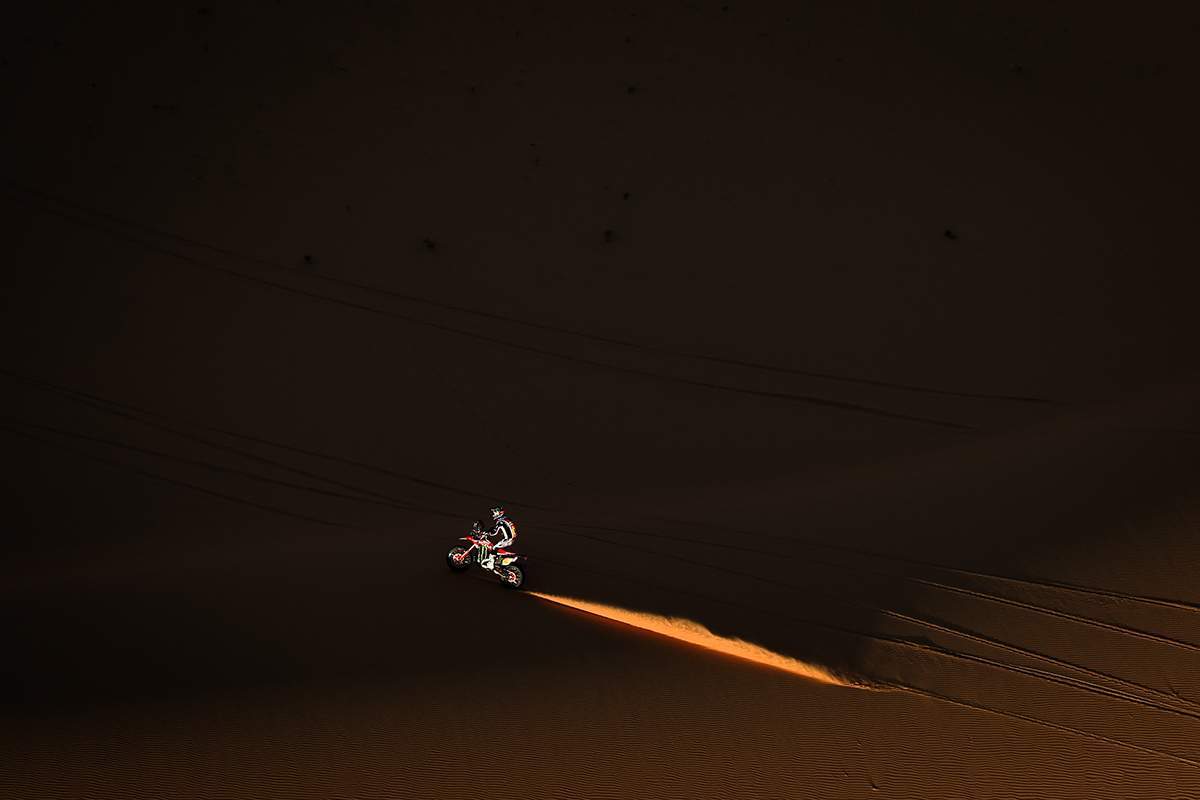
- Photo 1: Tosha Schareina, Monster Energy Honda HRC, Stage 8 of the 2026 Dakar, taken on 12 January 2026 near Wadi Ad-Dawasir (Saudi Arabia); archive photo. Photographer/rights holder: © A.S.O./F. Gooden/DPPI. Original source: dakar.com
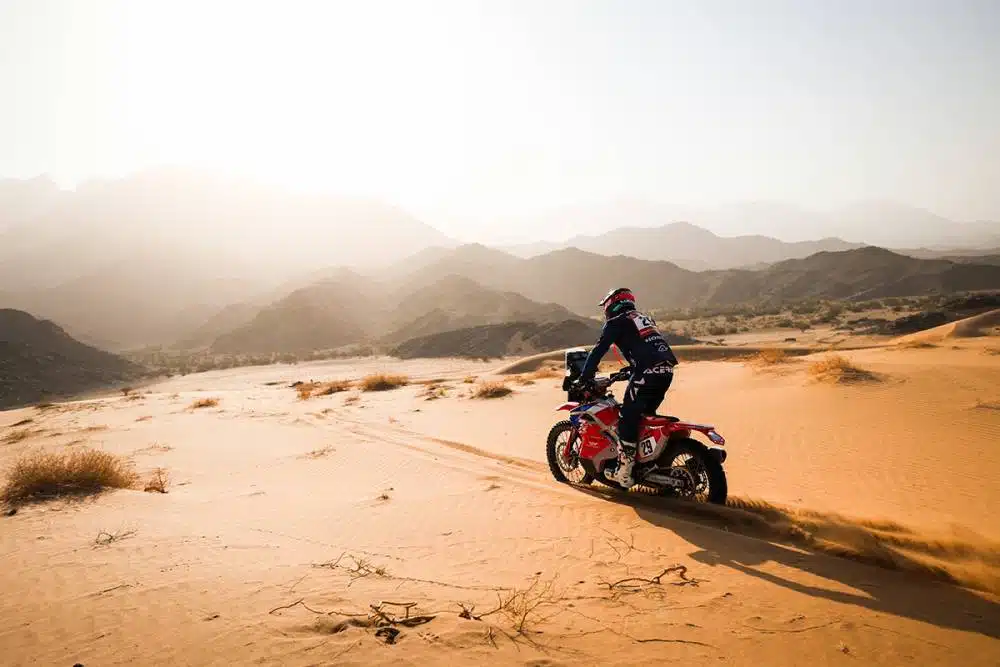
- Photo 2: Paolo Lucci, RSmoto Rally Team (Honda), Stage 12 of the 2026 Dakar, taken on 16 January 2026 between Al Henakiyah and Yanbu (Saudi Arabia); archive photo. Photographer/rights holder: © A.S.O./A. Vincent/DPPI. Original source: L’Essentiel de l’Éco