
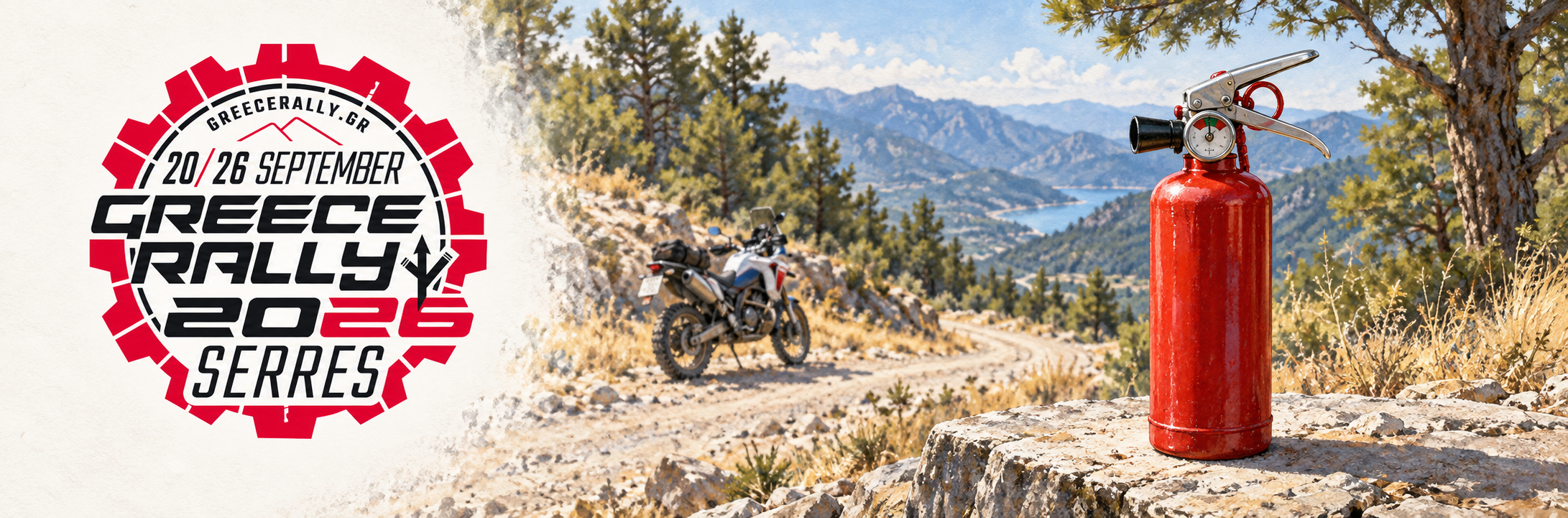
A small fire extinguisher on a rally bike: what looks like a detail in the briefing points to a bigger issue. Citing Forest Service requirements, the Greece Rally demands at least 0.5 kg for motorcycles. For amateur riders this is of practical importance – and a reason to look at forest and vegetation fires in popular rally regions of Greece, Croatia and Bosnia and Herzegovina.
Greece Rally: at least 0.5 kg for motorcycles
In its official briefing, the Greece Rally specifies at least 0.5 kg for motorcycles and 3 kg for SSVs and quads. Vehicles are to be equipped accordingly before each race day. The organisers offer to supply fire extinguishers.
This documents a requirement for this event. It cannot be taken to mean a general fire extinguisher obligation for all motorcyclists in Greece. The short note also does not conclusively explain which designs, test standards and mountings are accepted. Participants should therefore agree their specific model before travelling, or clarify with the organisers the availability and issue of a unit.
Rally landscapes are also sensitive natural areas
Forest tracks, dry meadows and long mountain sections make many rally routes appealing. They also lead through landscapes in which vegetation fires can spread under unfavourable conditions. This is not just about dense forest: grass and scrub vegetation are part of the picture too.
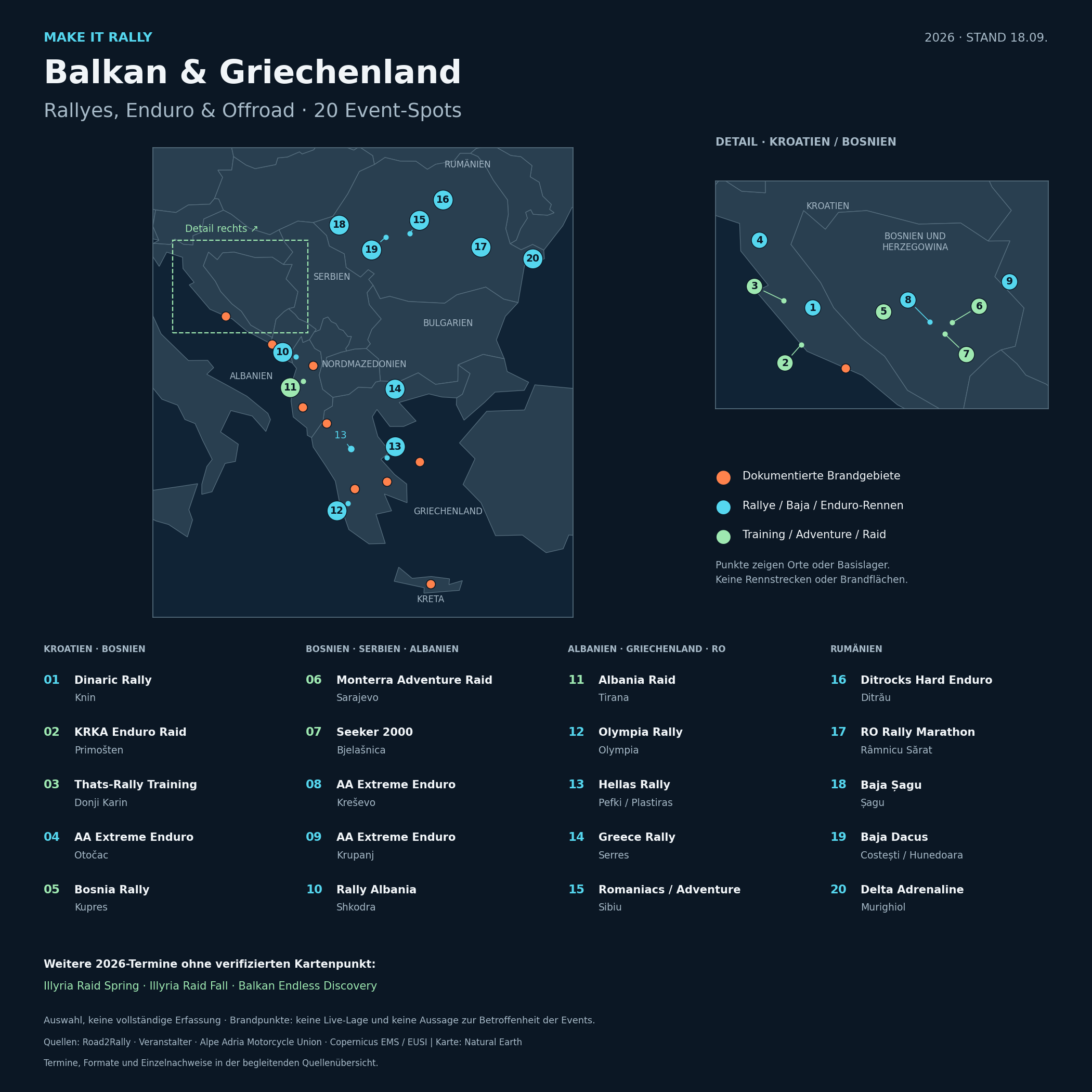
One example of the region’s importance in motorcycle rally sport is the Dinaric Rally with its base camp in Knin, Croatia. Earlier editions also went through Bosnia and Herzegovina; the organiser’s 2022 information documents marathon stages there. Such routes combine sporting experience with responsibility for the landscape being crossed.
The actual fire risk depends on factors including dryness, temperature, wind and local vegetation. A national figure therefore does not say how dangerous a particular rally stage is on a particular day. Likewise, the following figures do not show that rallies or motorcyclists cause fires.
How often does it burn? The trend since 2018
The following overview shows the number of forest and vegetation fires mapped by EFFIS in three relevant countries. It covers the full years 2018 to 2025 and the provisional interim figure for 2026.
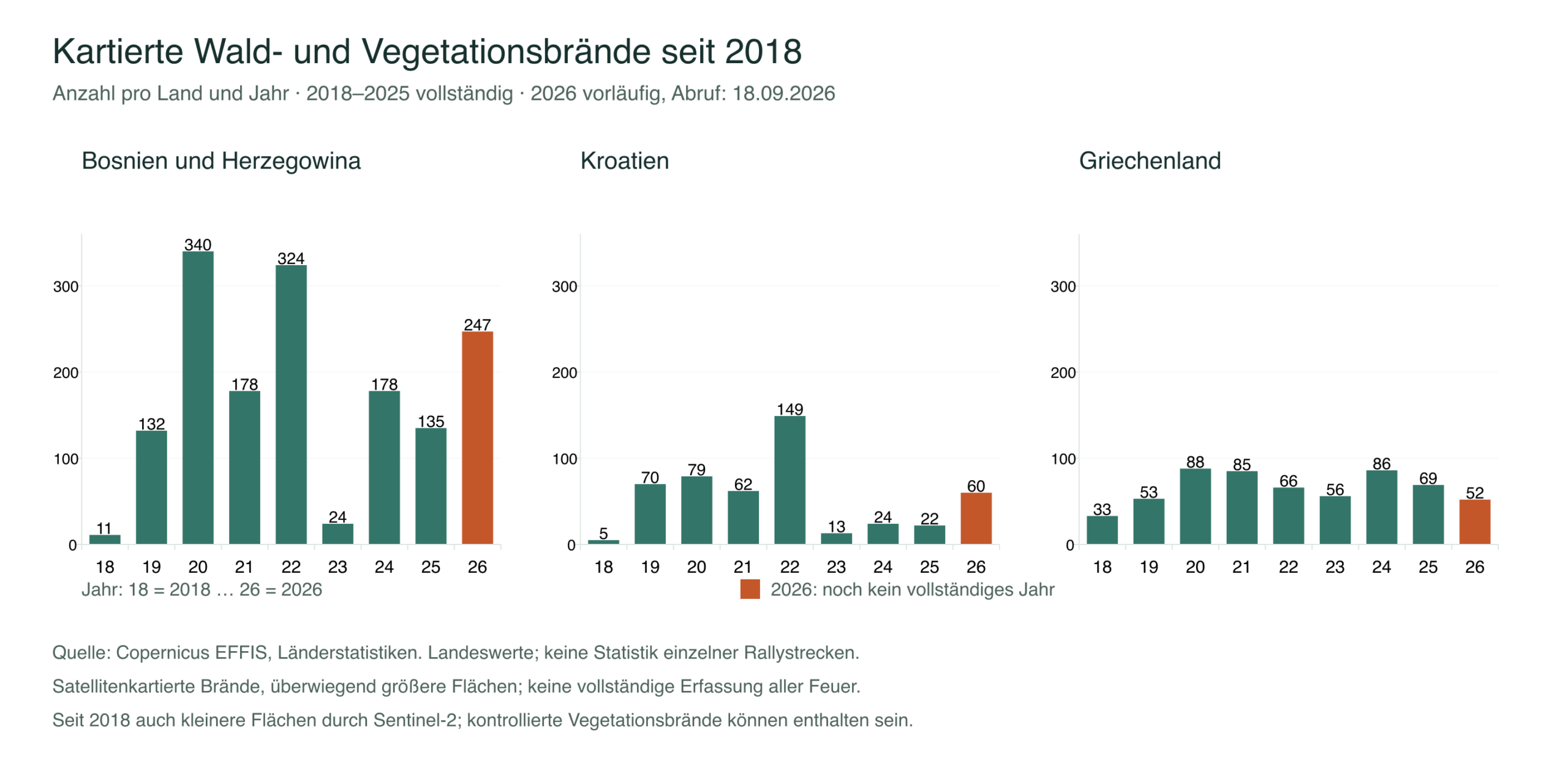
The number alone also does not describe the extent of damage: in 2023 Greece had 56 mapped fires, fewer than the 88 in 2020. The mapped burnt area, however, was considerably larger in 2023, at around 174,773 hectares, than in 2020 with 14,915 hectares.
For context: EFFIS is not a complete count of all fires or fire service call-outs. Satellite mapping mainly captures larger burnt areas; since 2018, Sentinel-2 imagery has also allowed smaller areas below about 30 hectares to be recorded. Controlled vegetation fires may be included. These limits are described in the EFFIS methodology.
Burnt area: a look beyond the Balkans
Besides the number of fires, the burnt area also shows how severely individual countries are affected. The following graphic takes the eight largest 2026 values from the RND overview as of 17 September 2026 and presents them anew. Greece and Croatia are highlighted.
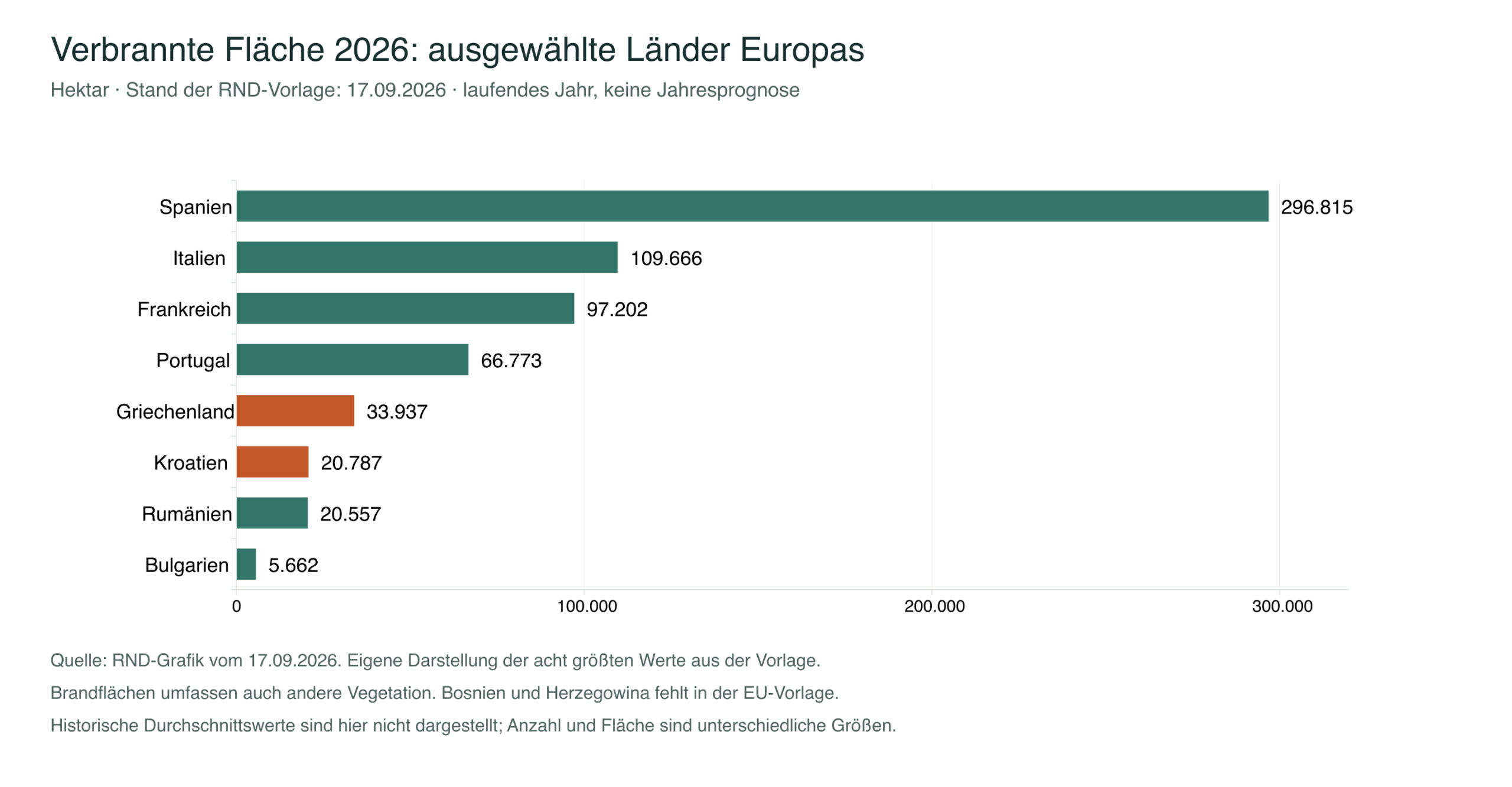
The source gives 33,937 hectares for Greece and 20,787 hectares for Croatia. These are national figures for the area burnt so far, not statements about the risk on individual rally routes. They also cannot be directly equated with the number of fires. The data of this graphic is dated one day before the annual table was retrieved.
The historical averages from the source are deliberately not used here: the screenshot does not clearly explain whether whole calendar years or the corresponding part of the year are being compared. No percentage increase over the long-term average is therefore derived from this graphic.
Climate change and heatwaves: why the danger may grow in future
Climate change is relevant to the longer-term outlook. The IPCC report on the Mediterranean region states with high scientific confidence that increasing heatwaves, together with drought and land-use change, can reduce vegetation moisture, lengthen the fire season and favour large, severe fires.
The IPCC’s physical assessment projects, at global warming of 2 °C and more above pre-industrial levels, an increase in drought and fire-favouring weather conditions in the Mediterranean. These are climate projections for warming levels, not predictions for an individual rally or a particular year.
This outlook is particularly relevant for Mediterranean-influenced rally regions. However, no blanket percentage forecast can be derived from it for individual areas of Croatia or Bosnia and Herzegovina: altitude, proximity to the coast and local conditions differ. For riders and organisers, it follows that heat and dry periods should be taken seriously in scheduling, route approval and daily briefings.
Check the current fire situation before travelling
An annual table is no substitute for a current situation map. The RND map of current fires and burnt areas in Germany and Europe is suitable as a supplementary overview. Directly from Copernicus, the EFFIS Current Situation Viewer shows fire reports, mapped areas and fire danger forecasts.
With any map, the date of the data and the selected period matter. For whether a rally route can be used, the organisers’ announcements and local official orders remain decisive.
What does “0.5 kg fire extinguisher” mean – and is there one for bikes?
For a classic powder extinguisher, the kilogram figure usually refers to the mass of extinguishing agent: 0.5 kg equals 500 grams of powder. Container, valve and bracket add to the weight carried. One example of a different extinguishing system is the PROTENG Zenova FX500: the supplier gives 0.5 kg of water-based filling and 0.75 kg total weight.
500 ml of contents, 500 grams of unit weight and 0.5 kg of extinguishing agent are different specifications. The Greece Rally briefing does not expressly explain how its weight figure is to be interpreted for different designs. Confirmation of the specific unit is therefore decisive.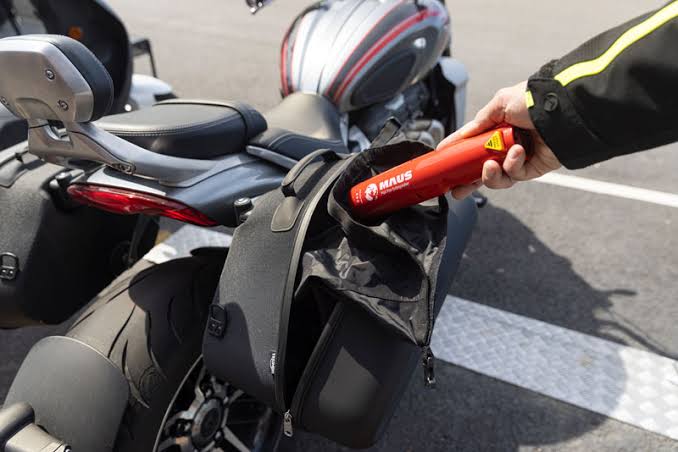
Compact units are already available:
- 0.5 kg powder extinguisher: Premier Fire Services in South Africa lists a Firemate of this size expressly also for motorcycles. This documents the size, but neither a European approval nor acceptance at the Greece Rally.
- 500 ml liquid extinguisher: The Firexo 500ml Aerosol is offered with a transport bracket. According to the manufacturer it is 295 mm tall and weighs 1.1 kg when filled. The volume figure is not automatic confirmation of a 0.5 kg requirement.
- Aerosol unit marketed for motorcycles: The MAUS Xtin Klein is, according to the manufacturer, 24 cm long and 480 grams in total weight. It uses a potassium-based aerosol technology and is not a 0.5 kg powder extinguisher. Its acceptance as a substitute must be expressly clarified.
The stated fire classes and suitability for the intended use are equally important. Product advertising aimed at motorcyclists is no substitute for confirmation by the rally organisers. For none of these examples is a Greece Rally approval documented here.
What amateur riders can do in practice
- Before departure: Read the current regulations and briefing, clarify which unit is accepted and agree a secure, quickly accessible mounting suited to off-road use.
- Before each riding day: Check hazard warnings, route changes and closures; inspect the fire extinguisher according to the manufacturer’s instructions.
- During breaks and at the bivouac: Keep hot vehicle parts away from dry grass. The German Fire Brigades Association (Deutscher Feuerwehrverband) expressly warns against hot surfaces coming into contact with vegetation.
- In case of fire: Alert the rally organisers or the fire brigade and put your own safety first. A small extinguisher is intended for an early response, not for fighting a spreading forest fire. If in doubt, retreat takes priority, as DFV and vfdb explain.
Will fire extinguishers be required more often in future?
The Greece Rally shows an already concrete requirement. The information page for Hellas Rally 2027 also lists a “Fire extinguisher flare” for motorcycles – though with different wording and without confirming that the same unit would be accepted at other events.
Our assessment: in rally regions prone to forest fires, requirements to carry small extinguishing devices could become more likely in future. This is a conceivable development also for events in Croatia and Bosnia and Herzegovina, for example as part of individual permits or in particularly dry conditions.
A corresponding general obligation for motorcycles, or an already announced introduction in these two countries, is not documented by the sources used here. Climate projections underline the importance of precaution; they do not predict a specific new rule. And a fire extinguisher does not make a closed route passable.
For amateur riders the practical conclusion remains clear: fire protection belongs in preparation alongside navigation, range and personal equipment. The short line in the Greece Rally briefing is a good reason to deal with it in good time.
As of: 18 September 2026. EFFIS figures are mapped national values; 2026 is provisional. Product details come from the linked suppliers. The outlook on future event requirements is an editorial assessment.