
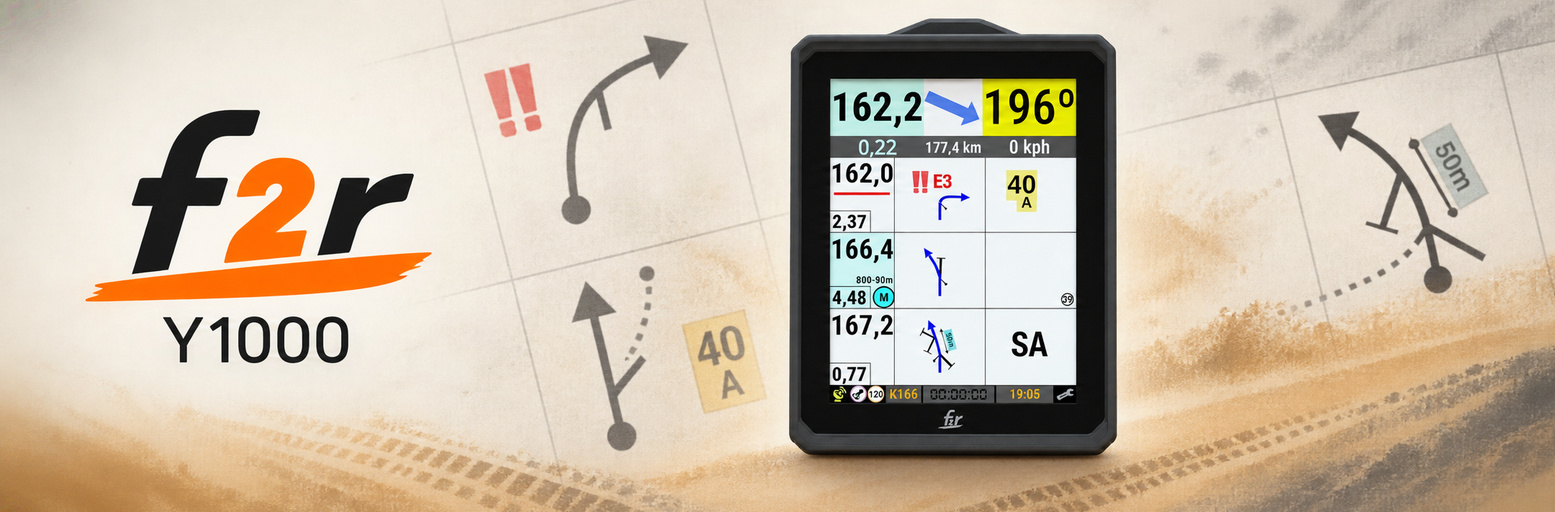
Almost 1,800 euros for a digital roadbook: the F2R Y1000 has to earn its higher price off-road. What matters is legibility during a special stage, a dependable power supply and controls that work with gloves on. But how well has the device actually been tested, where can it be bought – and when is a simpler tablet with TerraPirata enough?
As of 19 September 2026. Research and assessment based on the linked sources; no test ride of our own.
Availability: sold out at the manufacturer, listed by a retailer
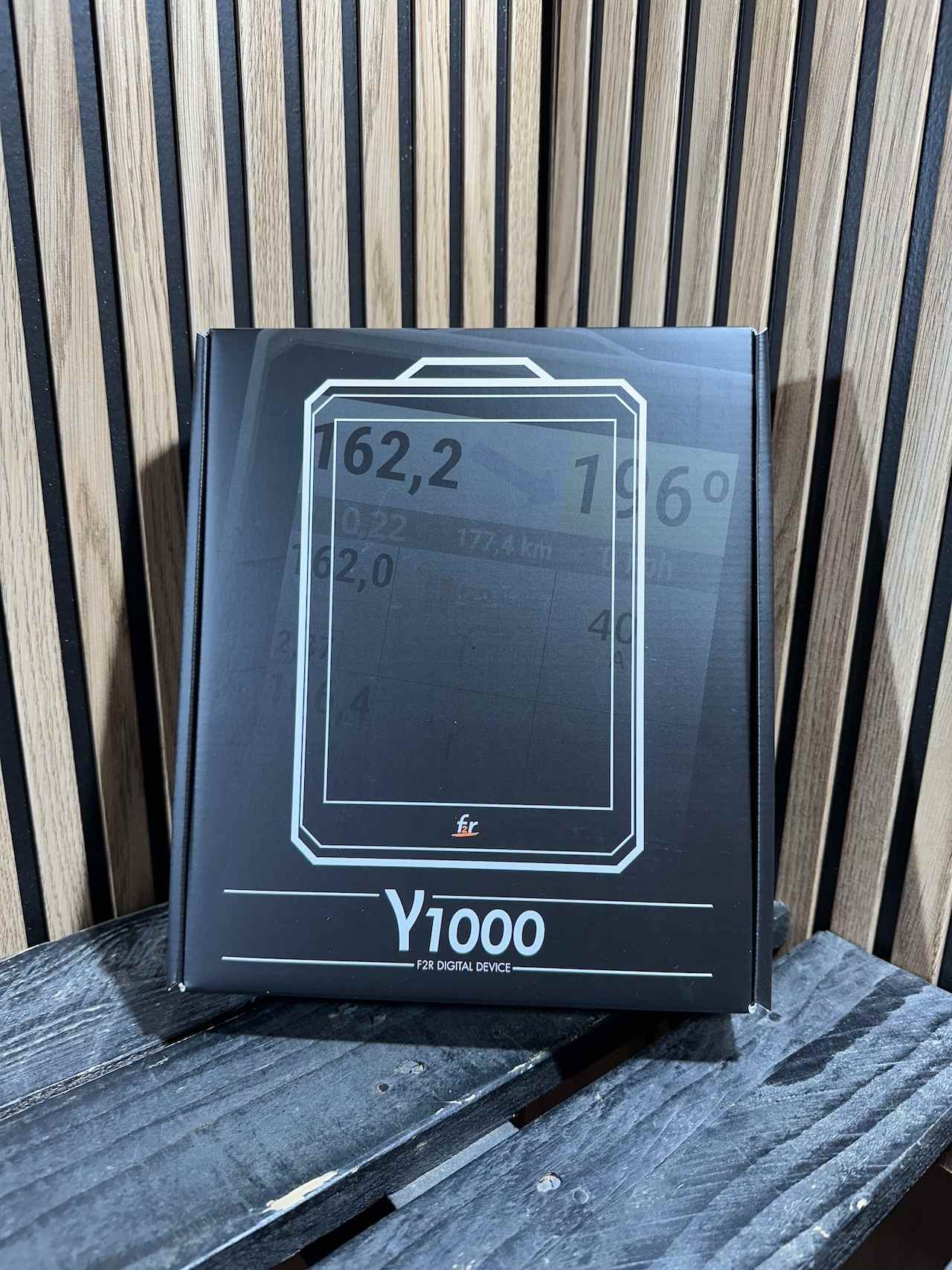
Availability differs between suppliers. When checked directly, the F2R shop showed the Y1000 at 1,795 euros as sold out. A notification for new stock is offered; no firm restocking date was given there.
THATS-RALLY listed the single unit at 1,735 euros including VAT, also sold out. OFF-THE-ROAD, by contrast, showed 1,785.95 euros including VAT and dispatch in four days. These are snapshots of shop displays, not reserved stock. Shipping costs, delivery country and the final checkout price belong in the comparison.
The scope of delivery matters too: with the F2R single unit, the DR001 handlebar remote control is available separately. A suitable motorcycle mount and any desired accessories may be extra. Before a rally, therefore, budget for the complete, mountable system. Scope of delivery at F2R
What do you pay for with the Y1000?
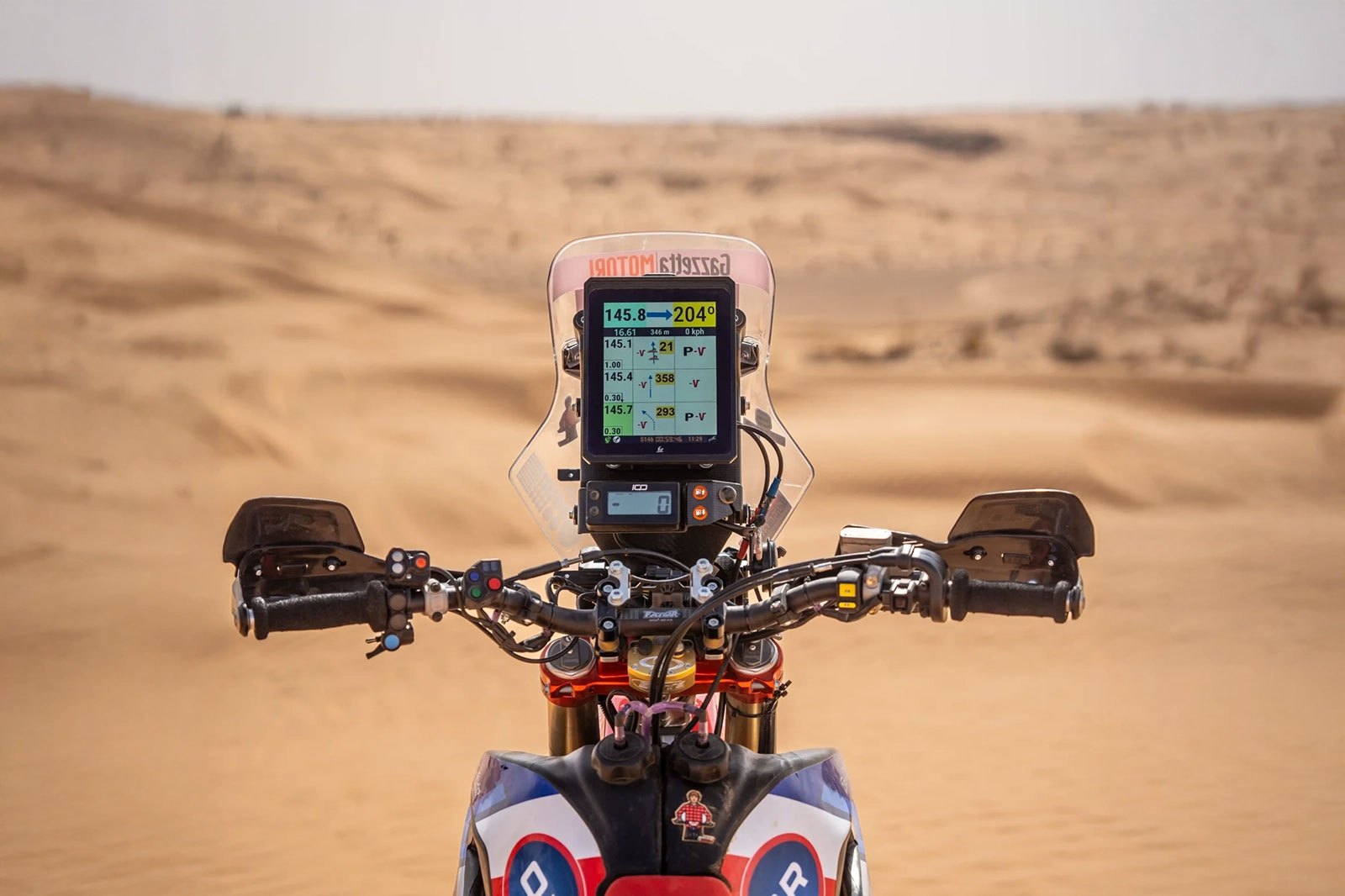
F2R cites a CNC-milled aluminium housing, four-millimetre display glass and a 4:3 display designed for roadbooks. The cooling concept is said to allow permanently high brightness. The detachable GammaBox contains the Android electronics; the dedicated roadbook app bundles, among other things, distance counter, compass heading and waypoint guidance. Other Android apps remain usable. These are manufacturer claims, not performance figures measured by us. Technology and functions
The practical value therefore lies mainly in the hardware and controls designed for rallies. Anyone who repeatedly struggles with hard-to-read displays or a sensitive power connection may benefit from a specialised device. Whether that justifies the premium depends on your own use.
One peculiarity is worth knowing: according to TerraPirata’s device overview, the Y1000 has no internal battery and is powered directly from the motorcycle. A cleanly routed and fused power supply is therefore part of the overall system. At around 1.3 kilograms, a sturdy mounting bracket is also needed. F2R weight specification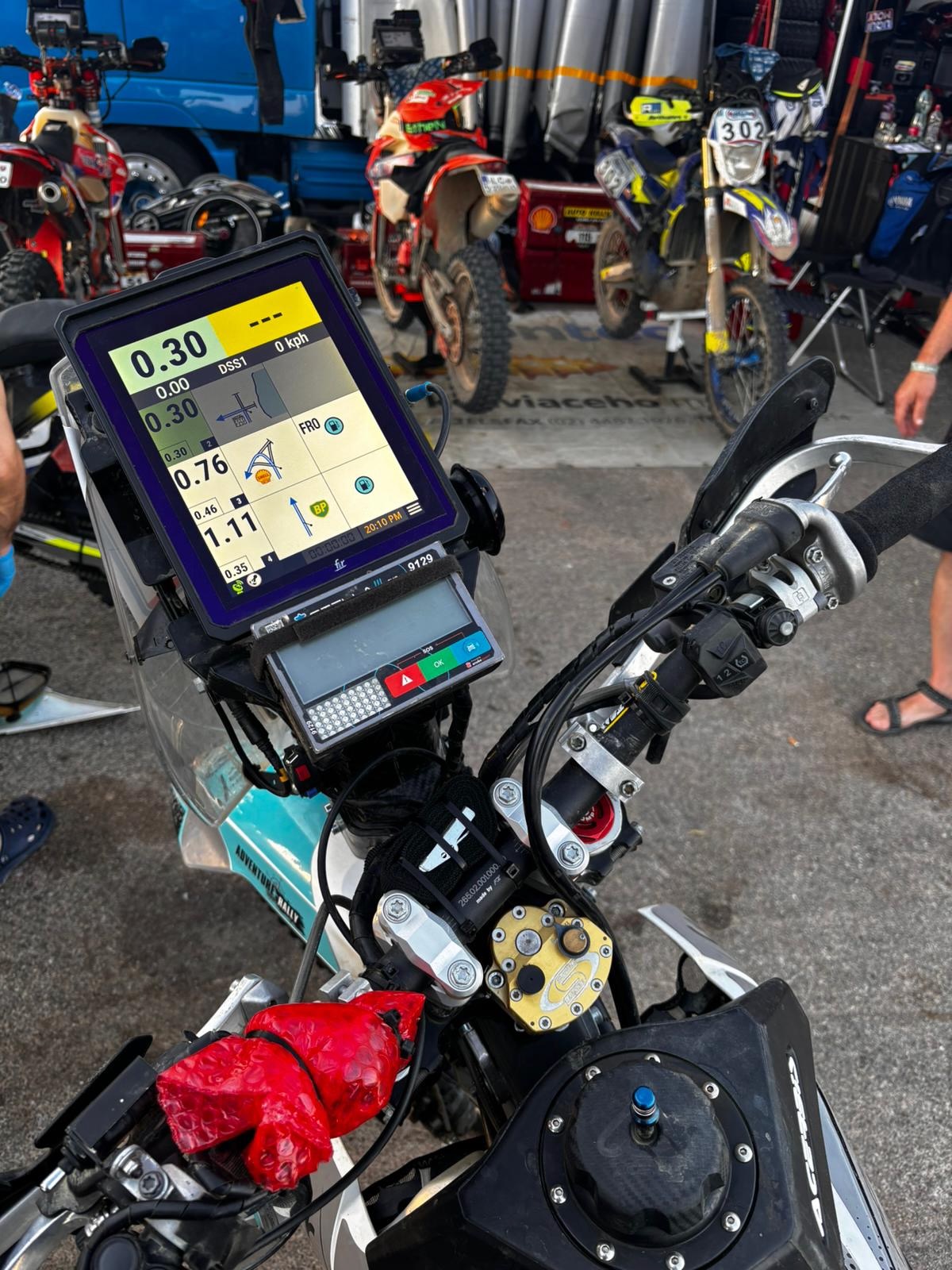
Real rally use: reliable indications, with limits
F2R puts development at three and a half years and more than 55,000 test kilometres. This figure comes from the manufacturer. F2R product description
More concrete are the rider reports published on the F2R development page: Isaac Feliu cites the Hellas Rally and Rodibook 2024, Iván Merichal the Addax Rally 2024 in Morocco. Another tester describes seven race days at the Greece Rally 2024. This gives traceable indications of competition use. However, selected feedback on a manufacturer’s page is no substitute for an independent comparison test. Nor does the involvement of Dakar riders prove the Y1000 was used in racing at the Dakar.
Particularly revealing is Sascha Christof’s personal Hellas Rally report at OFFROADCRACKS from June 2025. He praises the legibility in sun and dust and the easy loading of the daily roadbooks. After a water crossing, however, the display froze and went black.
After consulting an F2R developer, he says, water droplets on the touchscreen are said to have triggered a standby-like state. Activated touch protection would, according to the report, have prevented this; the relevant instruction was missing at the time. The author mentions other riders affected. This is an important practical finding, but not proof of water damage. Whether later software versions have changed the behaviour cannot be deduced from it.
Our assessment: The Y1000 has actually been used in rally conditions. The sources do not, however, justify a blanket promise that it works without faults in all conditions. Before the first race, touch protection, remote control, restart and roadbook import belong in your own training.
Simple tablet with TerraPirata: a sensible start?
The TerraPirata app “Rally Roadbooks” is offered free of charge to riders and already includes important navigation functions such as distance counter, compass heading and waypoints. For learning tulips, distances and CAP headings, a suitable existing tablet can therefore be an economical way in.
The app alone does not make an everyday device rally-ready, however. Mount, power supply, handlebar control, sunlight and wet conditions must suit the use. In its own practical evaluation, TerraPirata describes, among other things, damaged charging ports and problems with mounts on various devices. These experiences relate to specific models and setups; they are not a general failure statistic.
F2R and TerraPirata are also not mutually exclusive: the Y1000 supports TerraPirata’s roadbook distribution via RDS. What is being compared is therefore mainly different hardware solutions within a partly shared software world. Anyone starting cheaply should calculate the price of the fully mounted setup – not just the price of the tablet. A free app also does not mean that roadbooks and events are free.

Concrete alternatives: Beginner, Medium and Premium
The following tiers are our assessment by budget and purpose, not a ranking from a direct comparison test. A more expensive device does not automatically improve the rider’s navigation technique. What matters is how well the complete setup suits training, tours and races.
Beginner: Samsung Galaxy Tab Active3 with TerraPirata
For first roadbook training sessions, a refurbished Tab Active3 is a concrete money-saving option. At Back Market, the 64 GB version was offered at the time of research from around 90 euros, plus the stated service fee. Condition, seller and scope of delivery affect the price. A sturdy motorcycle mount, a suitable power supply and, where applicable, a compatible handlebar remote control come on top.
This suits riders who want to learn to read tulips and correct distances. The limits lie particularly in legibility in harsh sun and the durability of the charging connection; TerraPirata describes corresponding experiences for the Active series. With an older used device, check the battery, ports and compatibility with the current app version before buying. For the first multi-day rally, the finished setup should already have survived several longer training sessions.
Medium: DMD-T865X with off-road mount
For regular training and a mix of touring, off-road and roadbook, the DMD-T865X is a sensible middle way. Thork Racing shows an entry price of 730.01 euros including the tax applied in the shop. The offer includes a mount and the power wiring; note the mount variant and delivery country when it comes to the final price. According to the manufacturer, the eight-inch device offers a 1,300-nit display, Android and an unlocked DMD2 licence.
For more demanding off-road riding, we would choose the heavy-duty off-road mount with screwed power connection on offer. This is a different version from the road mount. A handlebar remote control and the fixing to the specific motorcycle must be budgeted for separately. The advantage over a cheap tablet lies in the package already designed for motorcycle use; this does not amount to proven superiority over the Y1000 in direct rally comparison.
Premium: Carpe Iter Caretta as an alternative to the Y1000
Anyone seeking a high-quality device for roadbooks and demanding journeys should compare the Caretta Navigation Kit. The Carpe Iter shop lists it at 799 euros excluding VAT; at a calculated 19 per cent, that is 950.81 euros, plus shipping. The checkout for the delivery country remains decisive. Included are the device, charging mount, an AMPS base for a 12 mm crossbar and a fused power cable. A separate handlebar remote control is not part of the kit as listed.
Carpe Iter cites a seven-inch display with 2,200 nits, Android, an internal battery and a vibration-damped mount. The display values are manufacturer claims and not a jointly measured brightness comparison. Our assessment: an interesting premium alternative for riders who switch a lot between roadbook and map navigation. With its 4:3 format and dedicated roadbook controls, the Y1000 remains particularly interesting for targeted rally use. Multi-day rally experiences with other Carpe Iter models cannot automatically be transferred to the Caretta.
Carpe Iter CI Pad V4C: older premium alternative in comparison
The CI Pad V4C belongs alongside the Caretta as a model in its own right. Its features make it particularly interesting for riders who already own a V4C or find a suitable offer for a complete setup. The V4C product description from VenturaX cites Android 13, an internal battery with a nominal 9,650 mAh and a device weight of around 650 grams. No current complete price is set here: tablet, mount, power supply and remote control must fit together for the specific offer.
For demanding terrain, the screwed M8 power connection is relevant. Carpe Iter offers the Lightweight Holder either active with charging contacts or passive for supply via M8. A separate GPS tripmaster can work alongside; for shared handlebar control, the combination of Terrain Command III and Tripmaster HUB described below applies. As a result, its distance values are not automatically transferred to the tablet app.
Our assessment: An existing, working V4C does not have to be replaced merely because of the Y1000’s higher GPS rate. What matters is whether reception, sun legibility and power supply work reliably in your own training. When buying an older device, check the battery, charging ports and software state. V4C, V4D and Caretta have different GNSS equipment; their technical specifications must not be mixed up.
The fair price comparison is therefore: tablet or kit plus handlebar control, suitable motorcycle mounting and complete power supply. With the Beginner setup, more has to be put together yourself; DMD and Caretta already bring part of these components with them. The Y1000 is priced above them and should offer a concrete added value for your own use.
GPS when riding by roadbook: why 25 Hz can make a difference
The fast GNSS receiver is a factual argument for the Y1000’s higher price. F2R cites up to 25 position updates per second. Carpe Iter gives 10 Hz for the Caretta; for the older V4C, the linked retailer description cites up to 5 Hz. For the Samsung Tab Active3 and the DMD-T865X, the manufacturer documents checked here publish no clear rate. Attributing 1 Hz to them across the board, or presenting a lower rate as proven, would therefore not be reliable.
A worked example shows the significance: at 90 km/h, the motorcycle covers 25 metres per second. Between two position fixes there are 25 metres at 1 Hz, 2.5 metres at 10 Hz and one metre of travel at 25 Hz. These are intervals along the route travelled, not position errors. More frequent measurements can improve the response of the tripmeter and CAP display and the recording of tight corners. How quickly the display actually responds also depends on the app, operating system and filtering. Furuno: position update and track
Two decimal places for kilometre figures are already commonplace in modern roadbooks. They correspond to a display step of ten metres. A display of 12.34 km therefore does not yet promise a distance measurement accurate to ten metres. Position accuracy, accumulated distance and display resolution are different quantities. Even a fast receiver needs good reception and a suitable distance calculation; shadowing, signal reflections and deviations from the surveyed route remain relevant. In principle, more accurate GPS measurement can make the difference between turning now and turning later.
| Device | Receiver, rate and accuracy | Display and housing |
|---|---|---|
| Samsung Tab Active3 | GPS, GLONASS, BeiDou and Galileo. Specific GNSS module, Hz rate and specified position accuracy not stated in the product description checked. | 8 inches, 1920 × 1200 pixels; 213.8 × 126.8 × 9.9 mm without additional mount. Samsung |
| DMD-T865X | Integrated GNSS, connection for external antenna. Module and Hz rate not clearly published. Product page states under 1 m, Thork shop by contrast at most 2 m; measurement standard not explained. | 8 inches, 1280 × 800 pixels; 207 × 137.5 × 15 mm without mount. DMD / Thork |
| Carpe Iter CI Pad V4C | u-blox M9N, up to 5 Hz according to model-specific retailer description; GPS, GLONASS, Galileo, BeiDou and SBAS. No statistically defined accuracy of the complete tablet given there. Do not carry over the dual-band specifications of the V4D or Caretta. | 7 inches, 1920 × 1080 pixels; 200 × 135 × 20 mm. With mount, according to the offer, 220 × 140 × 40 mm. V4C specification at VenturaX |
| Carpe Iter Caretta | Dual-band GNSS L1/L5, 10 Hz, under 1 m according to the manufacturer; statistical definition not stated there. Specific module designation not given. | 7 inches, 1920 × 1200 pixels; 194 × 129 × 22–33 mm. Charging mount: 203 × 165 × 50–56 mm; do not simply add these dimensions. Carpe Iter |
| F2R Y1000 | GPS, Galileo, GLONASS and BeiDou; up to 25 Hz, under 1 m CEP. Module designation and received frequency bands not stated in the datasheet. | 8 inches, 4:3, 768 × 1024 pixels; 210 × 160 × 37 mm. Portrait mounting. F2R datasheet |
| ERTF Unik 4 Moto | Event system with external GPS antenna. Module, Hz and a comparably defined metre figure not documented in the materials checked. | Own damped mount; allow 35 mm clearance behind the GPS for connectors. No reliable complete housing dimensions in the mounting instructions checked. ERTF mounting |
| RBI IRIS | GNSS navigation and waypoint control. Module, Hz and statistically defined accuracy not stated in the public description checked. | Various vehicle versions; check binding dimensions and mount for the specific enduro version with the organiser. RBI |
At F2R, CEP denotes a statistical circular error figure, usually referring to 50 per cent of position fixes under the respective test conditions. “Under one metre CEP” does not mean that every measurement point lies within one metre. Without identical test conditions and the same statistical standard, the manufacturers’ accuracy claims are not directly comparable. Ruptela: accuracy figures / u-blox: datasheet and practice
Our verdict: The documented 25 Hz are a concrete technical advantage over the Caretta, specified at 10 Hz, and the V4C, which according to the retailer manages up to 5 Hz, provided the application used can process this data rate. Together with housing, display and controls, they can explain the higher price. Generally superior component quality or better route accuracy than all alternatives has not been demonstrated by this. For tight sequences of tulips, fast, stable data and a easily operated distance correction count together.

Dakar and W2RC: is the F2R Y1000 approved by the FIM?
A blanket FIM approval of the Y1000 as a replacement for the prescribed Dakar/W2RC system could not be established. F2R describes its roadbook software as FIM/FIA-compliant. This manufacturer statement is not, however, an event-specific approval of the device.
The FIM W2RC Sporting Regulations 2026, version of 3 March, Article 29.3 in principle permit the digital displays provided by the organiser. Further displays require prior approval from the FIM Technical Director or Chief Technical Steward. Article 29.2 permits GPS odometers under the functional restrictions set out there, unless the supplementary regulations provide otherwise. No general permission for a freely usable Android tablet follows from this.
For the Dakar 2026, the motorcycle rules refer to ERTF, the mandatory rental of the GPS and, in the appendix, the Unik 4. The W2RC Rally de Portugal 2026 likewise prescribes the ERTF navigation system for all motorcycles in Article 10.5.2; Appendix 5 deals with its electronic Unik 4 roadbook.
The Unik 4 is thus part of the sporting control and safety equipment: roadbook, waypoint checks and the link to the Sentinel system form a procedure laid down by the organiser. A private app with a waypoint function does not replace this integration. For supplementary ERTF displays, Speedocap and the intended cables, for example, are relevant; other tripmasters need their own technical and regulatory check. ERTF documents
For the purchase decision, this means: the Y1000 can be a valuable training device and a race device at events with free choice of equipment. Anyone planning the Dakar or other W2RC rounds must budget for the system prescribed there. A higher GPS rate does not create an entitlement to start; the respective supplementary regulations, current bulletins and any written approval granted decide.
RBI and IRIS: factoring in the event’s system
The RBI IRIS system combines digital roadbook and navigation with functions for tracking, race control and safety. The focus here is on integration into the running of an event.
A concrete example is Baja Europe 2026: according to participant information, all race classes use IRIS, including Enduro. Rental of a unit is included in the entry fee; the mounting kit is provided separately. Navigation, waypoint control and GPS tracking run via the event system.
For this participation, buying a Y1000 therefore does not answer the equipment question on its own. A personal device does not replace a prescribed IRIS. Anyone who mainly rides such events should first check their requirements and included services. Equating a general IRIS purchase price with the F2R device price would be of little help for this rental model.
Who is the higher price worth it for?
- Beginners and occasional roadbook riders: A suitable tablet you already own, or a cheaper rugged one, with TerraPirata can be enough. The remaining budget can be invested in navigation training and first events.
- Regular rally riders with free choice of equipment: The Y1000 is interesting if sun legibility, the position updating of up to 25 Hz, housing and controls solve the previous weak points of your own setup. The documented rally use argues for serious consideration, but does not replace your own test.
- Participants in rallies with mandatory ERTF or IRIS: Plan the event system and its mounting first. An additional Y1000 must justify itself through further races, training or tours.
The Y1000 can be worth its price if its particular features are needed in your own rally routine. For simply displaying a digital roadbook, on the other hand, the high entry price is hard to justify. A sensible purchase begins with the race calendar, the right setup and an honest look at the problems the new device is actually meant to solve.