
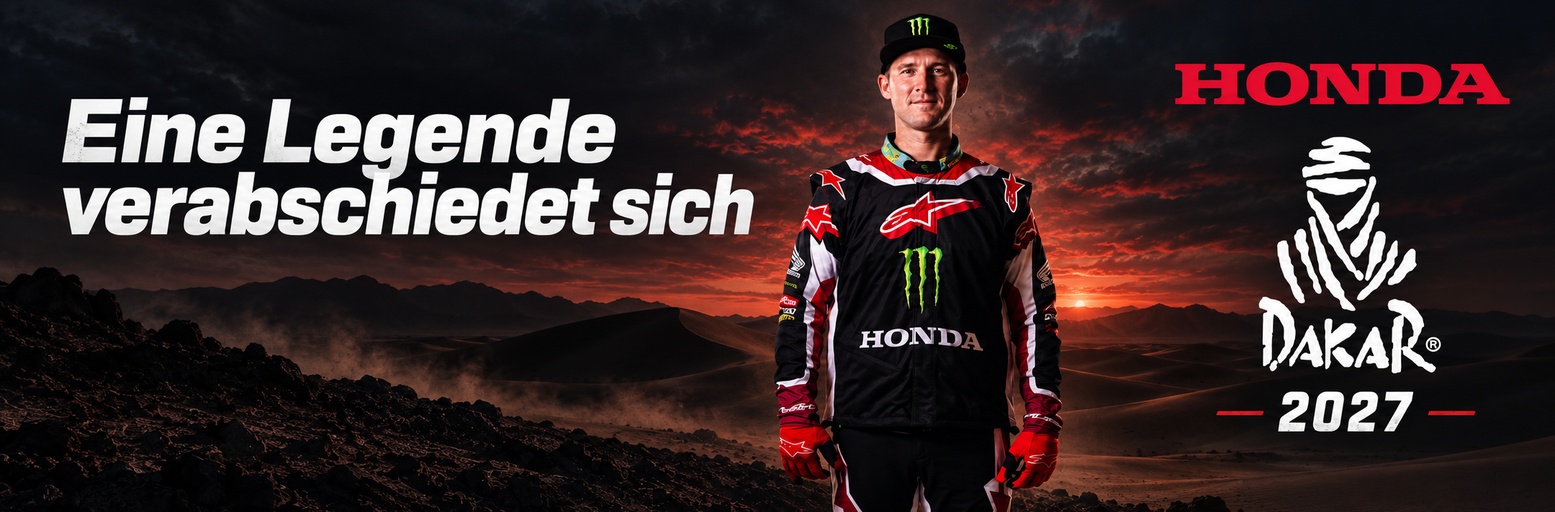
Dakar 2027 is set to end one of the most influential motorcycle careers in recent rally raid history. Ricky Brabec has announced that his next Dakar is also meant to be his last race on a motorcycle. The American is not going quietly: after the dramatic defeat of 2026, he is aiming everything at the biggest prize once more, a third Dakar win for Honda. For Monster Energy Honda HRC, this also marks the start of a strategic rebuild, because after the departure of Skyler Howes, which has already taken place, the factory team now also has to replace Brabec’s experience, speed and importance for the US market.
Dakar 2027 as a final assault
Brabec made his decision public as early as May 2026. After the Dakar, he said, he had decided to add one more year with Monster Energy Honda HRC and to concentrate fully on the 2027 edition. The official W2RC publication reports his statement unambiguously: it will be his last year on the motorcycle, and for Dakar 2027 he wants to make the best possible attack one more time.
This also means that his announced farewell season is already under way. Rallye du Maroc 2026 is therefore listed as his last appearance in Morocco on two wheels. Whether the Dakar actually remains his final motorcycle race depends, of course, on whether the planned schedule can be carried out without injury or a change of programme. The announcement itself, however, is confirmed.
From Californian desert racing to the world stage
Brabec’s career began far from the big rally raid bivouacs. Born on 21 April 1991 in California, he came to motorcycles via BMX and American desert racing. The long, fast and rough races in the south-west of the USA shaped a riding style that would later suit the Dakar perfectly: a high base pace, calm in open terrain and the ability to stay focused for many hours.
His breakthrough in the USA came in 2014. That season, according to Honda Racing, he won the Hare & Hound, Best in the Desert and SCORE championships as well as, among others, the Baja 1000, Baja 500 and Baja 250. Brabec was no longer just a strong talent from the American desert, but a candidate for the international rally raid scene.
Honda recognises the potential
Honda brought Brabec to the Abu Dhabi Desert Challenge in 2015. In his first international rally raid appearance, he was the best junior and finished fifth overall. A year later, aged 24, he started the Dakar for the first time and reached ninth place overall as a rookie, a result that confirmed his rapid rise.
His first Dakar stage win followed in 2017. The following years also showed how tough this rally is: Brabec had to retire several times even though his pace was already good enough for the front. 2019 was especially bitter, when a technical failure stopped him on the way to a possible overall win. Those setbacks gave rise to the controlled riding style that later became his trademark.
In 2020, Brabec writes American motorsport history
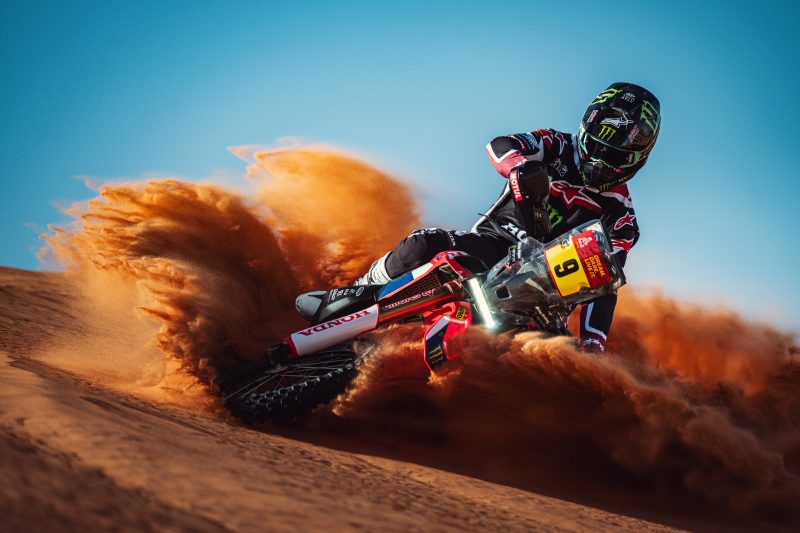
The breakthrough came at Dakar 2020. Brabec won the motorcycle category and became the first American ever to win the Dakar. At the same time, he ended Honda’s long drought in the motorcycle class. The victory made him a rally raid icon in the USA and gave Honda the role of a Dakar-winning team again.
The success was no one-off. In 2021, Brabec finished second and won four stages. In 2022 came seventh place, and in 2023 he had to retire after a crash. But instead of losing touch, he returned stronger in 2024.
The second Dakar win as a mature masterpiece
In 2024, Brabec took his second overall Dakar win. He took control early, led from stage six and ultimately won by 10 minutes and 53 seconds ahead of Ross Branch. It was a different kind of win from 2020: less the breakthrough of an exceptional talent, more the tactically controlled performance of an experienced rally raid rider.
In the same year he also won the Desafío Ruta 40. The season confirmed that Brabec could be fast not only on certain Dakar days, but mastered navigation, strategy and looking after his equipment over an entire rally. Even an injury before Dakar 2025 did not keep him out of the top five; further podium finishes followed later in Abu Dhabi, South Africa and Morocco.
Two seconds that shape the final attempt
Dakar 2026 delivered perhaps the most dramatic moment of his career. Brabec was on course for his third overall win when he made a navigation error seven kilometres from the finish. Luciano Benavides ultimately won by just two seconds, according to the Dakar organisation the closest finish in the history of the rally.
This defeat gives the announced farewell in 2027 a particular tension. Brabec is up against not only the next generation and the strongest factory teams, but also the memory of those two seconds. A third win would place him firmly alongside the great multiple winners of the motorcycle class. But even without this final chapter, his significance is already secure.
How Honda is reshaping its RallyGP squad after Brabec
A finished Honda line-up for the period after Dakar 2027 has not yet been published. The starting position can nevertheless be seen clearly: Skyler Howes and Honda parted ways at the end of June 2026, and Brabec’s contract and motorcycle career are said to end with Dakar 2027. That would leave a core of Tosha Schareina and Adrien Van Beveren from the former RallyGP line-up.
Schareina is likely to move even more into the role of first title contender in sporting terms. The Spaniard has the pace for stage wins and overall victories and belongs to the younger generation around whom Honda can build the next Dakar cycle. Van Beveren confirmed a new two-year contract in 2026 and provides the necessary counterweight: plenty of Dakar experience, strong navigation and the ability to fight for the podium in a long rally. Honda would thus still have speed and routine in its RallyGP squad, but no direct replacement yet for Brabec’s particular strength on fast desert stages.
The successor is to come from Honda’s Rally2 team
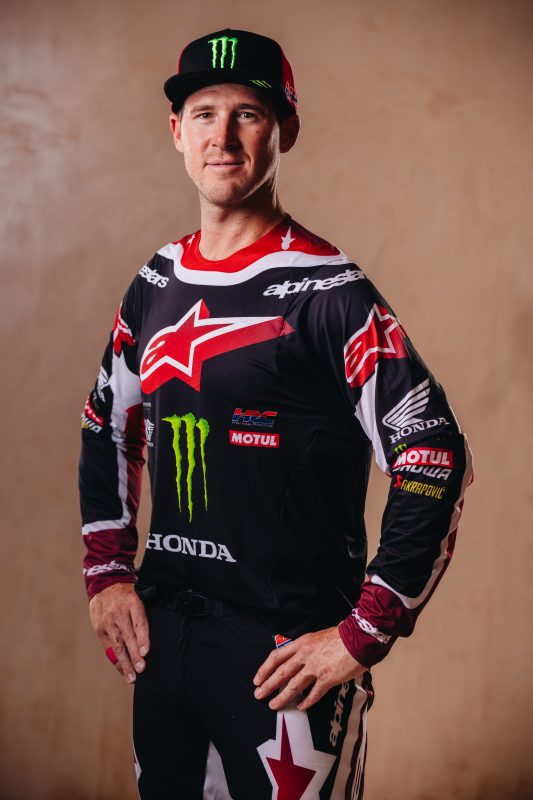
The most important strategic statement comes from team manager Ruben Faria. Honda wants to promote riders to the RallyGP squad from its own Rally2 team in future, rather than poaching established top riders from other manufacturers. The Rally2 programme set up in 2026 is therefore not just a customer sport project, but the factory team’s youth department and at the same time Honda’s answer to the coming generational change.
In sporting terms, much currently speaks for Martim Ventura. The Portuguese rider reached the Rally2 podium on his Dakar debut in 2026, then won the Desafío Ruta 40 in his class and collected further wins and podium finishes. He appears the most developed of the young riders at the moment and would therefore be the most logical candidate for an early RallyGP promotion.
Preston Campbell also has a strong starting position. The American led the Rally2 standings at Dakar 2026 for several days and finished his debut on the podium. His background in American desert racing makes him additionally interesting: in sporting and marketing terms, he could take on part of the role Brabec has shaped at Honda. However, Campbell has less international rally raid experience than Ventura, so Honda might develop him in Rally2 for another season.
Bruno Crivilin is the third internal option. The experienced enduro rider joined the Rally2 programme in 2026, has already won a W2RC stage in Argentina and, because of his link to Honda Brasil, is also interesting for an important market. For an immediate regular RallyGP seat after Dakar 2027, he currently appears less developed than Ventura or Campbell, but he widens Honda’s choice and makes the youth programme less dependent on external transfers.
The most likely Honda scenario
From the confirmed personnel decisions and Honda’s own youth strategy, the most likely model is a RallyGP core of Schareina and Van Beveren, complemented by at least one rider promoted from Rally2. Ventura currently has the strongest sporting position, while Campbell, as Brabec’s American successor, offers a particularly coherent long-term story. A staggered solution would therefore also be possible: Ventura moves up to RallyGP first, while Campbell keeps gaining experience and is prepared specifically for a later move.
It remains open whether Honda will field three RallyGP motorcycles permanently or expand again to four machines. An immediate external star signing appears less likely after Faria’s statement, but would not be ruled out in the event of injuries or an unexpected dip in performance. For now, only the direction is certain: Honda does not want to secure the post-Brabec era with a single big name, but with Schareina as the sporting fixed point, Van Beveren as an experienced Dakar rider and its own pipeline from the Rally2 class.
What remains of Ricky Brabec
Brabec has revived the link between American desert racing and international rally raid. He showed that a rider from the Baja and Hare & Hound school can master navigation, tactics and endurance at Dakar level. Two Dakar wins, another second place, numerous stage wins and his role in Honda’s resurgence define his record.
His farewell from the motorcycle does not have to mean the end of his racing career. Brabec has raised the possibility of a switch to cars and explicitly pointed to the still open question of when an American will win the Dakar in a car. There is no concrete programme so far. For now, Dakar 2027 remains: a last start on two wheels, a last attack for Honda and at the same time the handover to a team that is already preparing strategically for life after its American figurehead.