
Last updated on 4. November 2026
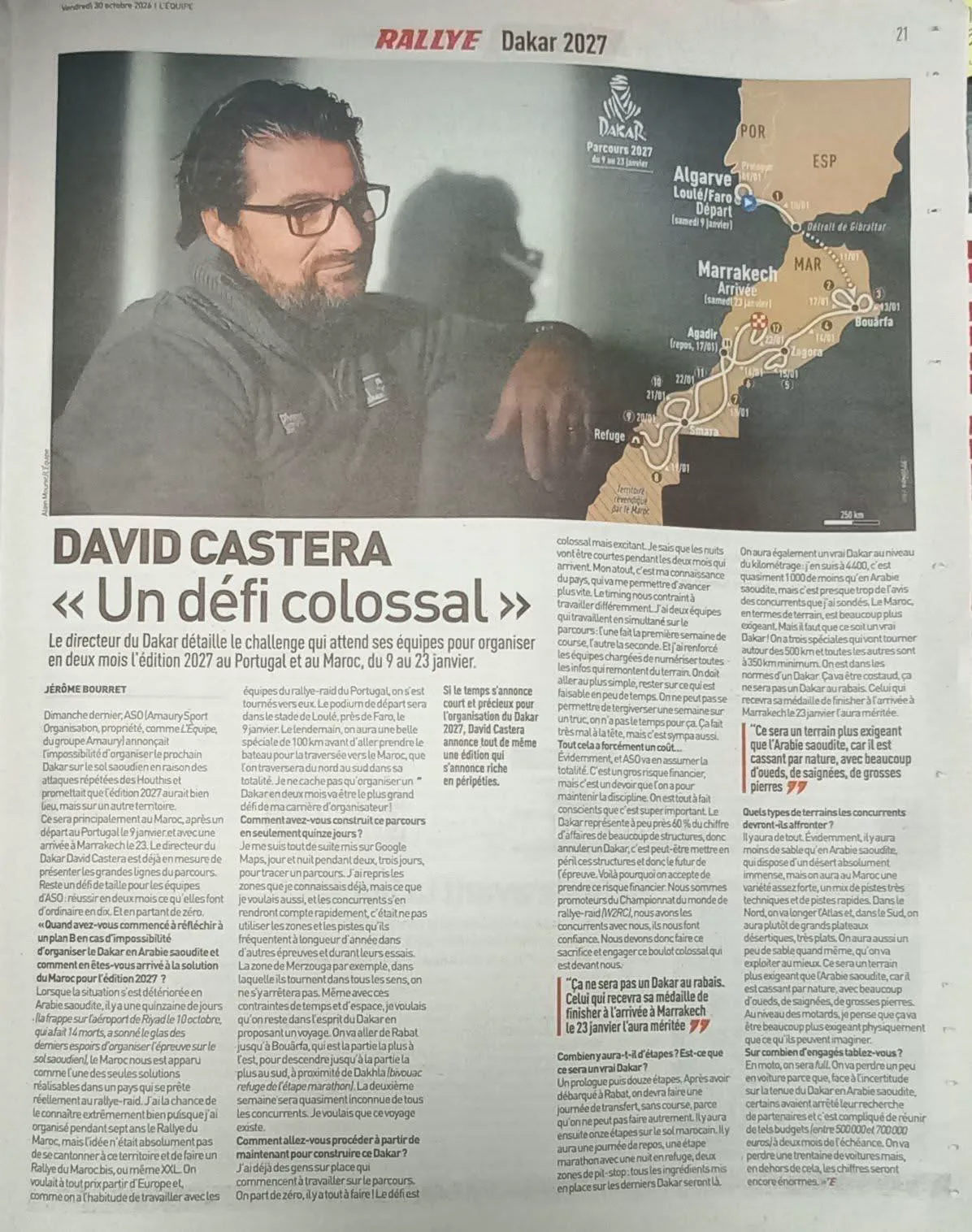
Dakar director David Castera describes the short-notice replanning of the 2027 Dakar as the biggest task of his career so far. “I won’t hide the fact that putting on a Dakar in two months will be the biggest challenge of my career as an organiser,” he told the French sports daily L’Équipe (translated from French). The interview by Jérôme Bourret appeared in the edition of Friday, 30 October 2026, on page 21. Make It Rally has the printed page as material.
Why the Dakar is moving
According to L’Équipe, the organiser ASO (Amaury Sport Organisation) announced on Sunday, 25 October 2026, that the 2027 Dakar cannot take place in Saudi Arabia because of repeated Houthi attacks. The newspaper cites an attack on Riyadh airport on 10 October. The route for Portugal and Morocco was presented on 30 October. In its statement, the FIA refers only generally to “recent developments in the region” (translated) and announces that the Dakar is due to return to Saudi Arabia in 2028 for its 50th edition.
The official key facts
According to the FIA of 30 October 2026, the 49th Dakar will be moved “exceptionally” to Portugal and Morocco. The move is still subject to approval by the FIA World Motor Sport Council. The key facts known so far:
- Dates: 9 to 23 January 2027, opening round of the 2027 FIA World Rally-Raid Championship (W2RC).
- Start: Loulé-Faro in the Algarve. The programme begins at the Algarve Stadium, the service park opens on 5 January, and scrutineering runs from 6 to 8 January.
- Format: prologue on Saturday, 9 January, followed by 12 stages.
- Distance: 7,824 km in total, of which 4,341 km are timed special stages.
- Bivouacs and finish: six bivouacs, finish on Saturday, 23 January, in Marrakech.
According to the FIA, it is the Dakar’s first return to the African continent since 2007. The route map in L’Équipe shows, after the prologue in Portugal, the crossing of the Strait of Gibraltar, a bivouac in Bouârfa and the rest day on 17 January in Agadir.
Castera: not a copy of the Rallye du Maroc
By his own account, Castera designed the course on a computer: he sat down at Google Maps straight away, for two or three days, day and night. He used known zones but deliberately avoided areas and tracks that competitors drive all year in other races and tests. As an example he names the region around Merzouga, where there will be no stop.
By his own account, Castera organised the Rallye du Maroc for seven years. The idea, however, was expressly not to run a second Rallye du Maroc in XXL format. The route runs from Rabat to Bouârfa in the far east and then deep into the south, close to Dakhla, where the Refuge bivouac of the marathon stage is to be located. On a marathon stage, competitors spend the night without their service crews. The second week will be new territory for almost all competitors. The map in L’Équipe shows the southern section as territory claimed by Morocco.
In Portugal, according to Castera, a special stage of 100 km is planned after the prologue, followed by a ferry crossing to Morocco. After arrival there is a transfer day without timing, then eleven stages in Morocco with one rest day, one marathon stage with a night at the Refuge and two pit-stop zones.
Discrepancies between the interview and official figures
Two points in the interview do not exactly match the official figures. On distance, Castera says he arrived “at 4,400” km, almost 1,000 fewer than in Saudi Arabia (translated). The FIA gives 4,341 km of special stages. The interview does not make clear whether Castera’s figure refers to the same stage of planning and only to the special stages. As the arrival point in Morocco, Castera names Rabat. The excerpt of the FIA statement available does not name an arrival port, so this point cannot be resolved conclusively here.
On stage lengths, Castera says three special stages are around 500 km and all the others at least 350 km. According to him, some of the competitors asked even considered the total distance almost too long.
Two teams, full risk for ASO
For preparation, according to Castera, two teams are working on the route at the same time, one on the first and one on the second week of the race. The teams, which digitise all the terrain data, have been reinforced. ASO bears the costs in full. “It is a big financial risk, but it is our duty to preserve the discipline,” Castera said (translated). The Dakar accounts for about 60 per cent of turnover for many teams. A cancellation could have endangered these structures and with them the future of the rally. ASO is also the promoter of the W2RC.
Terrain: less sand, more stones
Castera expects less sand than in Saudi Arabia, but a mix of very technical and fast tracks. In the north the route runs along the Atlas, in the south across large, very flat desert plateaus. There will still be some sand. “It will be more demanding terrain than in Saudi Arabia, because it is by nature a bike-breaker, with many wadis, gullies and large stones,” he said (translated). Wadis are dried-up riverbeds.
For the motorcycle riders, in his assessment, it will be physically much harder than they can imagine. His promise for the finish in Marrakech: “It won’t be a bargain-price Dakar. Anyone who receives their finisher’s medal at the finish in Marrakech on 23 January will have earned it” (translated).
Entry: bikes full, gaps among the cars
In the bike category the field is full, Castera said. In the car category he expects to lose about 30 vehicles. Because of the uncertainty over holding the event in Saudi Arabia, some teams stopped looking for partners, and budgets of between 500,000 and 700,000 euros are hard to raise two months before the start. Apart from that, the numbers remain “enormous”. These figures come from the organiser, entry lists are not yet available and the numbers have not been independently verified.
Sources and image credits
- L’Équipe, Jérôme Bourret: “David Castera: ‘Un défi colossal'”, interview, print edition of 30 October 2026, page 21 (held by the editorial team as material MA-0022). All quotations from David Castera are translated from French.
- FIA: “Dakar to return to Africa in 2027 as Portugal and Morocco set to host 49th edition”, 30 October 2026: fia.com
- Photo: page 21 of L’Équipe of 30 October 2026 with Castera portrait and route map. Image credit: material MA-0020 (Make It Rally, media library), taken on 4 November 2026. Photo on the newspaper page: Alain Mounic/L’Équipe. Original source: https://mediathek.invalid/248f9347-c0aa-4eeb-b214-0351f40d06be/WhatsApp%20Image%202026-11-04%20at%2007.55.14.webp